Noah Smith’s post (HT: MR) on what students actually gain from college is a reminder that not all acquired skills are necessarily related to subject matter or academics. His list is the following:
1) Motivation,
2) Perspective, and
3) Human networks
I’m not in full agreement with his analysis except perhaps for #3 but it served as a reminder that in my post that learning classical music seems to take all the fun out of learning music - it’s not necessarily about the music. M claims that learning the notes and to play teachers perseverance and discipline. Someone else claimed that if nothing, all the recitals that one has to go through teaches confidence through public appearances.
Wednesday, June 13, 2012

Saturday, June 9, 2012
Petula Dvorak, Jerry Sandusky and me
I can imagine only standing by and watching - part of the conspiracy of silence. It is easy to think that I would have done the ‘right thing’ but it’s hard for me to know what I would have done.
The article in the New York Times about sexual abuse at the Horace Mann School reminded me of how easy it is to turn away from something that is unfolding right before your eyes. In a reminder that real victim of all kinds of crime is trust, the author has this quote:
“It’s counterintuitive, but sexual abuse emotionally binds the child closer to the person who has harmed him, setting him up for a life plagued by suspicion and confusion, because he will never be sure who he can really trust. And in my experience, this is by far the worst consequence of sexual abuse.”
What would I have done if I had witnessed something inappropriate as some had seen Jerry Sandusky do? Would I have thought - ‘Hey! That’s borderline sexual abuse. I have to stop this guy.’ Or would I have gone the route of Joe Paterno - report it and then assume that I had done my duty.
It was therefore difficult to read about this local crime and ask whether I might have done the right thing if I had been there. Here’s Petula Dvorak:
Geniuses working at the Apple store in Bethesda heard bone-chilling screams, grunts and thuds coming from the Lululemon Athletica shop next door to them one night last March. The manager even got another employee to walk over to the wall and listen for a while, just to assure her that, no, she wasn’t just hearing things.
In case you want to think they demurred, red-faced, after realizing what they’d heard was after-hours loveplay or iron-yoga poses, the Apple store manager testified that unnatural human sounds were accompanied by a woman saying: “God help me. Please help me,” and “Talk to me. Don’t do this.”
Still not sure something bizarre is going on?
The Apple store manager, Jana Svrzo, told police: “I heard someone say, ‘Stop, stop, stop.’ And then, ‘Oh God, stop.’ ”
Hmm. What to do when you hear something like this?
…
If it were the reasonable, civilized society we believe that we occupy, the store employees would call 911 and tell the dispatcher that, maybe they’re being silly, but they are hearing something unusual next door that police might want to check it out.
Instead what they did was nothing. Nothing at all.
The noises on the night of March 11 came from a horrific killing. Svrzo and her co-worker were listening to Jayna Murray, who worked at Lululemon, suffer 322 wounds. The sounds were hammer, knife, wrench, rope and metal bars making contact with a human being.
Or consider this item:
The kidnapping and death of Barbara J. “Bobbie” Bosworth from the Springfield Mall in 2008 was one of the most horrific crimes in this region in recent memory. An innocent woman walking to her car on a Saturday afternoon was abducted at gunpoint, driven to Prince William County, forced into a convenience store to buy beer for her teenage attackers, and then killed when they crashed her car into a tree.
…
Customers in the PDQ Mart in Woodbridge said they pleaded with the store manager to call 911, or let them use his phone to call 911, because Bosworth was clearly in trouble. But during the 14 minutes Bosworth and the two teens were there, the store manager refused. The lawyer for the PDQ Mart did not return a call seeking comment.
What about this?
A man pulls at a woman’s arm, calling loudly for her to come with him. She says ‘No!’ just as loudly. He tells her to do as he says. They’re both in their 20s or perhaps early 30s. Does a stranger walking by intervene?
I kept on walking.
It’s time to be afraid of not doing the right thing. It’s time to also believe that doing the wrong thing for the right reason is okay. At a time when we are more disconnected than ever from one another it is another reason to be in touch - even for total strangers.
Unfortunately in a society that lacks trust any attempt to do the right thing is met with mistrust - mistrust of motives, or fear of retaliation and lawsuits. This is the kind of society that we live in. Economists and sociologists laud the fact that countries that have the oxymoronic sounding ‘trust-enforcing’ institutions grow faster. But this same institution can turn around and slap you with a lawsuit just as quickly even though you may doing something (wrong?) for the right reason.
What is trust? The lesson is from BSG:
Lt. Sharon 'Athena' Agathon: How do you know? I mean, how do you really know that you can trust me?
Admiral William Adama: I don't. That's what trust is.
The article in the New York Times about sexual abuse at the Horace Mann School reminded me of how easy it is to turn away from something that is unfolding right before your eyes. In a reminder that real victim of all kinds of crime is trust, the author has this quote:
“It’s counterintuitive, but sexual abuse emotionally binds the child closer to the person who has harmed him, setting him up for a life plagued by suspicion and confusion, because he will never be sure who he can really trust. And in my experience, this is by far the worst consequence of sexual abuse.”
What would I have done if I had witnessed something inappropriate as some had seen Jerry Sandusky do? Would I have thought - ‘Hey! That’s borderline sexual abuse. I have to stop this guy.’ Or would I have gone the route of Joe Paterno - report it and then assume that I had done my duty.
It was therefore difficult to read about this local crime and ask whether I might have done the right thing if I had been there. Here’s Petula Dvorak:
Geniuses working at the Apple store in Bethesda heard bone-chilling screams, grunts and thuds coming from the Lululemon Athletica shop next door to them one night last March. The manager even got another employee to walk over to the wall and listen for a while, just to assure her that, no, she wasn’t just hearing things.
In case you want to think they demurred, red-faced, after realizing what they’d heard was after-hours loveplay or iron-yoga poses, the Apple store manager testified that unnatural human sounds were accompanied by a woman saying: “God help me. Please help me,” and “Talk to me. Don’t do this.”
Still not sure something bizarre is going on?
The Apple store manager, Jana Svrzo, told police: “I heard someone say, ‘Stop, stop, stop.’ And then, ‘Oh God, stop.’ ”
Hmm. What to do when you hear something like this?
…
If it were the reasonable, civilized society we believe that we occupy, the store employees would call 911 and tell the dispatcher that, maybe they’re being silly, but they are hearing something unusual next door that police might want to check it out.
Instead what they did was nothing. Nothing at all.
The noises on the night of March 11 came from a horrific killing. Svrzo and her co-worker were listening to Jayna Murray, who worked at Lululemon, suffer 322 wounds. The sounds were hammer, knife, wrench, rope and metal bars making contact with a human being.
Or consider this item:
The kidnapping and death of Barbara J. “Bobbie” Bosworth from the Springfield Mall in 2008 was one of the most horrific crimes in this region in recent memory. An innocent woman walking to her car on a Saturday afternoon was abducted at gunpoint, driven to Prince William County, forced into a convenience store to buy beer for her teenage attackers, and then killed when they crashed her car into a tree.
…
Customers in the PDQ Mart in Woodbridge said they pleaded with the store manager to call 911, or let them use his phone to call 911, because Bosworth was clearly in trouble. But during the 14 minutes Bosworth and the two teens were there, the store manager refused. The lawyer for the PDQ Mart did not return a call seeking comment.
What about this?
A man pulls at a woman’s arm, calling loudly for her to come with him. She says ‘No!’ just as loudly. He tells her to do as he says. They’re both in their 20s or perhaps early 30s. Does a stranger walking by intervene?
I kept on walking.
It’s time to be afraid of not doing the right thing. It’s time to also believe that doing the wrong thing for the right reason is okay. At a time when we are more disconnected than ever from one another it is another reason to be in touch - even for total strangers.
Unfortunately in a society that lacks trust any attempt to do the right thing is met with mistrust - mistrust of motives, or fear of retaliation and lawsuits. This is the kind of society that we live in. Economists and sociologists laud the fact that countries that have the oxymoronic sounding ‘trust-enforcing’ institutions grow faster. But this same institution can turn around and slap you with a lawsuit just as quickly even though you may doing something (wrong?) for the right reason.
What is trust? The lesson is from BSG:
Lt. Sharon 'Athena' Agathon: How do you know? I mean, how do you really know that you can trust me?
Admiral William Adama: I don't. That's what trust is.
Friday, June 8, 2012
Some productivity pictures
I don’t quite know how to interpret the data on multifactor productivity. Data is from Census and I cherry picked the lines to plot:

Compared to agriculture and durable manufacturing, construction productivity had been falling even before the 2008 recession. I thought that perhaps it had fallen post recession. The picture for durable manufacturing is one I would have expected - a downturn in a recession.

The trend is up for these service industries although transportation was the only industry to experience a fall in MFP.

These service industries have not seen any overall trend in the improvement in productivity. Even the much maligned or vaunted finance industry seems to only have experienced marginal gains.
Thursday, June 7, 2012
Why were manufacturing jobs a ticket to the middle class but service jobs are not?
The loss of manufacturing jobs as a ticket to the middle class has been a constant lament not just lately but since the 1980s when the economic supremacy of the United States was threatened by Japan. An Economist survey of manufacturing (gated) showed that while this decline was temporarily arrested in the late 90s the share of workers in manufacturing has continued on a downward slide since 2000. (Chart reproduced below.)

Moreover, earnings in the manufacturing sector also tends to be higher. See reproduced chart from the Economist below.



Moreover, earnings in the manufacturing sector also tends to be higher. See reproduced chart from the Economist below.
What has been missing from the discussion has been the role service jobs play as a road to the middle class (if any). One exception is this presentation at an FRBSF conference. Kathryn Shaw, et. al. explore the possibility that employment provided by “Modern Retail” defined as high growth retail stores could provide a way for workers to gain higher future earnings. These stores include Abercrombie, Staples, Wal-Mart, Whole Foods, Cotsco, Starbucks and others. They emphasize that while wages are low, unlike traditional manufacturing, these stores provide opportunities in terms of promotion from within - unlike traditional manufacturing and small retail firms. They also identify medium sized retail establishments as those that are likely to match the returns to education provided by the traditional manufacturing sector. (Two of their slides are below.)
Wednesday, June 6, 2012
Inspiring science
One of the often heard lamentations is the state of STEM in the US - that this country is not producing enough STEM graduates. (A previous post here.) The following chart shows the percentage of science and engineering degrees as a percentage of all bachelor degrees over time. From a high of 36% in the late 60s, the percentage has fallen to about 31% by 2008. (Data is from the NSF and was not available for 1999.)
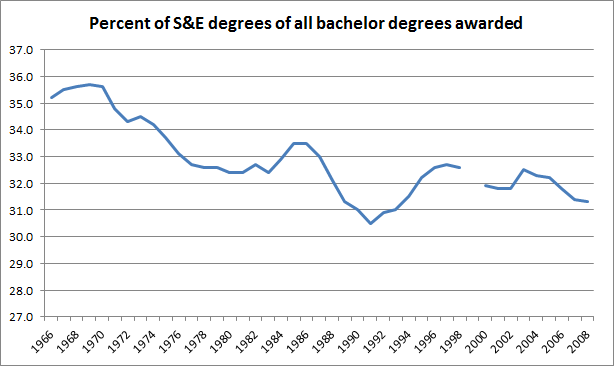
It is unclear how meaningful the 4-5% decline is but the trend might be cause for worry. It may also be a coincidence but the percentage peaked around the time of the Apollo missions. The space race was capturing the imaginations of the public and there was perhaps a palpable sense that going into engineering and science really meant something. There has never been another era like that - even the successes of Apple and Google have not matched the same level excitement. The dot-com bubble merely demonstrated that you didn’t really need a STEM degree to get rich - an internet domain with .com was sufficient - as long as you cashed out before the bubble popped. (In all fairness, the proportion of S&E degrees began climbing in the 90s just prior to this bubble.)
As the NYT makes clear, majoring in S&E is hard. And it is no help that students feel pressured to get an A in a hard course. One finger to point to is the S&E curriculum itself. Perhaps because or in spite of distribution requirements, S&E departments feel pressured to separate the wheat from the chaff quickly. One way to do this is to have hard first-year classes so that the less able flunk out. Even though these students may be interested in S&E but are either unprepared or easily distracted, they are dumped by the education treadmill to find something else to do. The signal from the curriculum is - don’t even bother - you’re not going to cut it.
Ironically S&E should be a field that embraces failures. By sending a black and white signal like the above it advances the notion that S&E have clear-cut answers to everything. Has the field forgotten that advancement in science depends perhaps as much on patience, perseverance and trial error as ability?
Drug discovery is one field where there are more dead ends than there are successes (and perhaps there should be a better way.) For the most part, Thomas Edison was self-taught and a tinkerer. It took several years of experimentation with different materials before the optical waveguide reached commercial viability.
One of kids favorite shows is Design Squad. If any show captures the excitement and frustrations of actually building something, this show does it and does it exceptionally well. The kids are well prepared with all kinds of shop skills - welding, sheet-metal work, design - and are mentored by MIT graduate Nate Ball. Even with a lot of guidance, failure is always an option but with each failure come important lessons.
S&E in essence has forgotten its roots. The curriculum perhaps needs to be redesigned. Peer teaching and other mentoring approaches need to be introduced. No doubt about it in my mind. But even with this there will never be the level of interest in S&E as there was in the past. Sadly, the only kind of engineering that students are interested in these days are the financial kind.
And an even sadder statement from Jeff Hammerbacher, former research scientist at Facebook: "The best minds of my generation are thinking about how to make people click ads," ... "That sucks."
It is unclear how meaningful the 4-5% decline is but the trend might be cause for worry. It may also be a coincidence but the percentage peaked around the time of the Apollo missions. The space race was capturing the imaginations of the public and there was perhaps a palpable sense that going into engineering and science really meant something. There has never been another era like that - even the successes of Apple and Google have not matched the same level excitement. The dot-com bubble merely demonstrated that you didn’t really need a STEM degree to get rich - an internet domain with .com was sufficient - as long as you cashed out before the bubble popped. (In all fairness, the proportion of S&E degrees began climbing in the 90s just prior to this bubble.)
As the NYT makes clear, majoring in S&E is hard. And it is no help that students feel pressured to get an A in a hard course. One finger to point to is the S&E curriculum itself. Perhaps because or in spite of distribution requirements, S&E departments feel pressured to separate the wheat from the chaff quickly. One way to do this is to have hard first-year classes so that the less able flunk out. Even though these students may be interested in S&E but are either unprepared or easily distracted, they are dumped by the education treadmill to find something else to do. The signal from the curriculum is - don’t even bother - you’re not going to cut it.
Ironically S&E should be a field that embraces failures. By sending a black and white signal like the above it advances the notion that S&E have clear-cut answers to everything. Has the field forgotten that advancement in science depends perhaps as much on patience, perseverance and trial error as ability?
Drug discovery is one field where there are more dead ends than there are successes (and perhaps there should be a better way.) For the most part, Thomas Edison was self-taught and a tinkerer. It took several years of experimentation with different materials before the optical waveguide reached commercial viability.
One of kids favorite shows is Design Squad. If any show captures the excitement and frustrations of actually building something, this show does it and does it exceptionally well. The kids are well prepared with all kinds of shop skills - welding, sheet-metal work, design - and are mentored by MIT graduate Nate Ball. Even with a lot of guidance, failure is always an option but with each failure come important lessons.
S&E in essence has forgotten its roots. The curriculum perhaps needs to be redesigned. Peer teaching and other mentoring approaches need to be introduced. No doubt about it in my mind. But even with this there will never be the level of interest in S&E as there was in the past. Sadly, the only kind of engineering that students are interested in these days are the financial kind.
And an even sadder statement from Jeff Hammerbacher, former research scientist at Facebook: "The best minds of my generation are thinking about how to make people click ads," ... "That sucks."
Thursday, May 31, 2012
Sticky expectations #2
From the LA Times:
The Facebook CEO and co-founder was recently in the capital city of Italy celebrating the wedding to his longtime girlfriend on their honeymoon, but on the Web, the young billionaire is getting grilled for his tipping habits -- or lack thereof.
Zuckerberg and his wife, Priscilla Chan, stopped by Nonna Betta, a kosher restaurant in Rome's Jewish Ghetto, where they spent 32 euros, about $40, on a meal that included fried artichokes, fried pumpkin flowers and ravioli stuffed with sea bass and artichokes, the Telegraph reported.
The couple thought the meal was "very good" but not good enough to tip, according to the Italian publication Corriere della Sera, which posted the story Monday.
Waiters at Nonna Betta were surprised no tip was left behind, not only because of Zuckerberg's wealth but also because they are accustomed to generous tips from American tourists, according to the Telegraph, which reported Zuckerberg also did not tip at another Roman establishment the previous night.
But should Zuckerberg really be blasted for not leaving a tip? If Zuckerberg hadn't left a tip at a restaurant in the U.S., that would be pretty lame of him, but in Italy tipping isn't exactly expected.
From the Globe and Mail (emphasis mine):
(In Mr. Zuckerberg’s defence, some have pointed out that a service charge is already included in the bill.)
...
But some argue Mr. Zuckerberg has been unfairly cast as a tightwad.
“It is not customary to tip for meal service in Italy,” Jodi Smith, of Mannersmith Etiquette Consulting, told MSNBC. In the United States servers have a lower minimum wage – tips are expected to supplement their income. “In Italy, servers are paid a living wage and tips are for extraordinary meals and/or service,” she says.
But while it may be okay for locals to skip leaving gratuities, it appears travellers, particularly Americans, tend to be held to a different standard.
“Zuckerberg not leaving a tip is a bit of a faux pas, but really because of Italian expectations of Americans,” Kathy McCabe of travel newsletter Dream of Italy, told USA Today. “Americans absolutely have a reputation for tipping, and many Italians have come to expect a tip when serving them.”
What are Italian expectations of Americans when it comes to bail-outs?
The Facebook CEO and co-founder was recently in the capital city of Italy celebrating the wedding to his longtime girlfriend on their honeymoon, but on the Web, the young billionaire is getting grilled for his tipping habits -- or lack thereof.
Zuckerberg and his wife, Priscilla Chan, stopped by Nonna Betta, a kosher restaurant in Rome's Jewish Ghetto, where they spent 32 euros, about $40, on a meal that included fried artichokes, fried pumpkin flowers and ravioli stuffed with sea bass and artichokes, the Telegraph reported.
The couple thought the meal was "very good" but not good enough to tip, according to the Italian publication Corriere della Sera, which posted the story Monday.
Waiters at Nonna Betta were surprised no tip was left behind, not only because of Zuckerberg's wealth but also because they are accustomed to generous tips from American tourists, according to the Telegraph, which reported Zuckerberg also did not tip at another Roman establishment the previous night.
But should Zuckerberg really be blasted for not leaving a tip? If Zuckerberg hadn't left a tip at a restaurant in the U.S., that would be pretty lame of him, but in Italy tipping isn't exactly expected.
From the Globe and Mail (emphasis mine):
(In Mr. Zuckerberg’s defence, some have pointed out that a service charge is already included in the bill.)
...
But some argue Mr. Zuckerberg has been unfairly cast as a tightwad.
“It is not customary to tip for meal service in Italy,” Jodi Smith, of Mannersmith Etiquette Consulting, told MSNBC. In the United States servers have a lower minimum wage – tips are expected to supplement their income. “In Italy, servers are paid a living wage and tips are for extraordinary meals and/or service,” she says.
But while it may be okay for locals to skip leaving gratuities, it appears travellers, particularly Americans, tend to be held to a different standard.
“Zuckerberg not leaving a tip is a bit of a faux pas, but really because of Italian expectations of Americans,” Kathy McCabe of travel newsletter Dream of Italy, told USA Today. “Americans absolutely have a reputation for tipping, and many Italians have come to expect a tip when serving them.”
What are Italian expectations of Americans when it comes to bail-outs?
Tuesday, May 29, 2012
YouTube in the classroom
When K1 was in 5th grade they learned French songs using YouTube. They learned this one by Francis Cabrel - Il Faudra Leur Dire.
Now that K2 is in 3rd grade, there seems to be more YouTube in the classroom. This time, it’s Yannick Noah - I remember him only as a tennis player.
Aux arbres citoyens seems to be a favorite. Les Lionnes is another and so is La Voix Des Sages.
Now that K2 is in 3rd grade, there seems to be more YouTube in the classroom. This time, it’s Yannick Noah - I remember him only as a tennis player.
Aux arbres citoyens seems to be a favorite. Les Lionnes is another and so is La Voix Des Sages.
Subscribe to:
Posts (Atom)