Showing posts with label Food. Show all posts

Thursday, October 10, 2013

Gravity

While the population of this earth is consumed with interest in the movie, with who is saying what about the realism of the movie I have just discovered a rather unexplored (in my part of the world) aspect of gravity.

Recently while browsing on the web (or maybe it was Amazon) I came across something called a periodic table of beer styles. The picture below is from here.


As if that were not cool enough, note the KEY at the bottom left hand corner which led me to the exploration of beer gravity. Here's the Wikipedia entry (which was noted as being too technical although I have seen some that are even more so):
Gravity, in the context of fermenting alcoholic beverages, refers to the specific gravity, or relative density compared to water, of the wort or must at various stages in the fermentation. The concept is used in brewing and wine making industry. Specific gravity is measured by a hydrometer, refractometer, pycnometer or oscillating U-tube electronic meter.
The density of a wort is largely dependent on the sugar content of the wort. During alcohol fermentation, yeast converts sugars into carbon dioxide and alcohol. The decline in the sugar content and the presence of ethanol (which is appreciably less dense than water) drop the density of the wort. The percentage of alcohol can be calculated from the difference between the original gravity (abbreviated OG) of the wort and the current specific gravity (abbreviated SG) of wort. By monitoring the decline in SG over time the brewer obtains information about the health and progress of the fermentation and determines that it is complete when gravity stops declining. If the fermentation is finished, the specific gravity is called the final gravity (abbreviated FG). For example, for a typical strength beer, OG could be 1.050 and FG could be 1.010.
A more friendly descriptive style is here:
... what brewers mean by gravity is simply the density of the wort compared to water. The full low-down on wort is beyond the scope of this post and will be discussed one day. For now it’s safe to understand that wort is unfermented beer. Another important bit about wort is that it’s full of sugar and when the wort starts fermenting (changing into beer) that sugar gets eaten and turned into alcohol (and some other stuff).

As I said before, gravity is the density of the wort compared to water and this is measured in comparison to water. So the density of water is 1.000 and the density of a wort may be 1.050, meaning the wort has 50 degrees of excess gravity and the beer has an original gravity of 50.

Once we’ve got the measurement of original gravity we can add yeast which starts the fermentation process. The yeast begins eating the sugar which makes alcohol (woo hoo) and carbon dioxide. Eating away at the sugar also makes everything less dense, thus lowering the gravity. Once most of the sugar has been eaten this means fermentation is done and you can now get the final gravity.

The original gravity was just the density of the wort compared to the water and so the final gravity is the density of beer compared to water. So we went from 1.050 down to something like 1.011, or a final gravity of 11. The difference in these two numbers plus some complex algebra, which I’m not getting into, is how brewers determine the alcohol by volume of a beer. The bigger the difference in original vs. final gravity means the stronger the beer. Which is why really strong beers are sometimes referred to as high gravity beers.

Another facet on the impact of gravity is that very different styles of beer can start at the same original gravity but can differ drastically in their finishing gravity. A high finishing gravity makes for a sweeter, maltier taste. A lower finishing gravity makes for a drier beer.
(emphasis are mine)

And here are some original vs. final gravity comparisons of different beers:
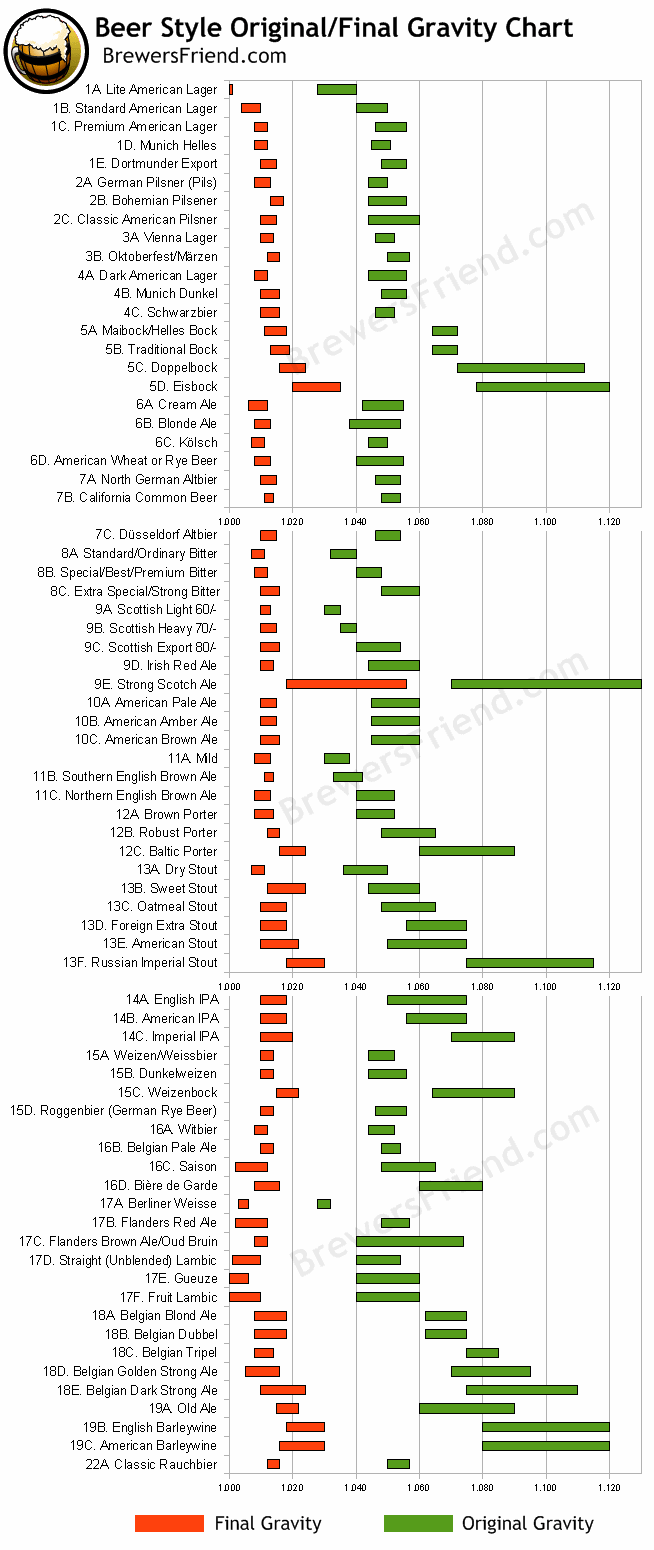
beer style gravity chart

Friday, May 14, 2010

Wal Mart versus Whole Foods

In general I found Corby Kummer's column interesting. What was more interesting was how we behave when what we expect isn't what we want it to be:

... the tasters were surprised when the results were unblinded at the end of the meal and they learned that in a number of instances they had adamantly preferred Walmart produce. And they weren’t entirely happy.

Yet, I have to applaud Wal Mart's efforts - whether it is sustainable is yet to be determined.

... buying local food is often harder than buying organic. The obstacles for both small farm and big store are many: how much a relatively small farmer can grow and how reliably, given short growing seasons; how to charge a competitive price when the farmer’s expenses are so much higher than those of industrial farms; and how to get produce from farm to warehouse.

... To get more locally grown produce into grocery stores and restaurants, the partnership is centralizing and streamlining distribution for farms with limited growing seasons, limited production, and limited transportation resources.

Walmart says it wants to revive local economies and communities that lost out when agriculture became centralized in large states. (The heirloom varieties beloved by foodies lost out at the same time, but so far they’re not a focus of Walmart’s program.) This would be something like bringing the once-flourishing silk and wool trades back to my hometown of Rockville, Connecticut. It’s not something you expect from Walmart, which is better known for destroying local economies than for rebuilding them.

... Michelle Harvey, who is in charge of working with Walmart on agriculture programs at the local Environmental Defense Fund office, summarized a long conversation with me on the sustainability efforts she thinks the company is serious about: “It’s getting harder and harder to hate Walmart.”

Friday, October 3, 2008

Tomato farming

Fascinating article on tomatoes:
A nearly two-story-tall mechanical harvester run by the Morning Star tomato-processing company clatters through the Sacramento Valley field. As the machine hums along at about three miles per hour, it uproots two rows of plants and lays them on a belt that conveys them to the top of the harvester, where the vines are sucked through a shredder and blown back onto the field as the tomatoes cascade onto other belts. Electronic eyes send signals to plastic fingers that pop out anything not red or green. Dirt clods, last year's squash and the errant toad and mouse tumble to the ground. The ripe fruit is funneled into a tandem trailer. In ten minutes, the machine gathers more than 22,000 pounds of Roma-type processing tomatoes.

I get into a pickup truck with Cameron Tattam, a Morning Star supervisor, and we follow a semitractor that hooks up to the trailer, pulls out of the field and then barrels down Interstate 5 to a Morning Star cannery outside the town of Williams. This 120-acre facility is the largest of its type in the world. During the three months of the local harvest, it handles more than 1.2 million pounds of tomatoes every hour. The tomatoes I just saw getting picked are washed down a stainless steel flume and plunged into a 210-degree cooker. The heat and pressure blow them apart. After passing through evaporators and cooling pipes, they will end up three hours later as sterile-packed tomato paste in 3,000-pound boxes. For the next two weeks, the facility will produce nothing but paste that is destined to become Heinz ketchup. Among Morning Star's other large customers are Pizza Hut, Campbell's Soup and Unilever, maker of Ragu.

And an interesting titbit:
The tomato itself is a seed-bearing fruit, but the Supreme Court, noting its customary place in the meal, classified it as a vegetable in 1893, for the purpose of deciding which tariff to charge for imports.