Thursday, July 7, 2011

Career paths

In a previous post, I said:

From where I'm sitting there are two ways to approach this [career choice]:
1. Here's what I want to do, how do I do it?
2. Here's what I want to study, what can I do with it?

I had a feeling this would come back to bite me. Thinking back to what I’ve done, this was/has/is not the way things have worked out for me. But let’s dwell on Megan McArdle instead:

Megan McArdle is the business and economics editor for The Atlantic. She has worked at three start-ups, a consulting firm, an investment bank, a disaster recovery firm at Ground Zero, and the Economist.

Megan McArdle was born and raised on the Upper West Side of Manhattan, and yes, she does enjoy her lattes, as well as the occasional extra dry skim milk cappuccino. Her checkered work history includes three start-ups, four years as a technology project manager for a boutique consulting firm, a summer as an associate at an investment bank, and a year spent as sort of an executive copy girl for one of the disaster recovery firms at Ground Zero . . . all before the age of 30.

While working at Ground Zero, she started Live from the WTC, a blog focused on economics, business, and cooking. She may or may not have been the first major economics blogger, depending on whether we are allowed to throw outlying variables such as Brad Delong out of the set. From there it was but a few steps down the slippery slope to freelance journalism. For the past four years she has worked in various capacities for The Economist, where she wrote about economics and oversaw the founding of Free Exchange, the magazine's economics blog. She has also maintained her own blog, Asymmetrical Information, which moved to the Atlantic Monthly, along with its owner, in August 2007.

Megan holds a bachelor's degree in English literature from the University of Pennsylvania, and an MBA from the University of Chicago. After a lifetime as a New Yorker, she now resides in northwest Washington DC, where she is still trying to figure out what one does with an apartment larger than 400 square feet.

How typical is a straight and narrow career path, i.e. a pre-med major who goes on to medical school and stays on as a doctor until retirement? Or a high-school drop-out who goes to work as a carpenter and stays in construction for the rest of his life, either in a skilled trade or construction manager?

Wednesday, July 6, 2011

The shape of the world to come

The Shape of the World to Come by Laurent Cohen-Tanugi was a little disappointing. I was hoping for some bold predictions but instead got some qualified ifs and perhaps. The book mainly delves into the implications of a decline in American and European influence in the geopolitical world, the rise of radical Islam, and the rising economic prowess of BRICs and how the America and Europe still has relevance. The main thrust of the book I thought was his discussion of the globalization of politics which while sounds nice is really about dealing with global issues at a multilateral level. A profile of Laurent Cohen-Tanugi is here. A presentation that he did for his book at the Carnegie Council is here. The book’s website says that “He is a regular columnist for Le Monde and Les Echos, sits on the boards of several international think tanks, and was recently appointed by the French government to reflect on the European Union's strategy in the global economy.” It’s nice to get a job whose description is to “reflect”. (only in France?)

Excerpts from his discussion at Carnegie:
What the book is really about is an analysis of the world we are entering into from a geopolitical perspective and how Americans and Europeans should prepare for it. It is really an attempt to analyze the new geopolitical paradigm that we are witnessing. In fact, it is quite surprising that less than 20 years after the end of the Cold War, the end of the bipolar world that structured international relations since 1945, we are already witnessing another change of historic significance. I think that this succession of two very major changes probably explains why there seems to still be a gap in perception that we are entering into a new world. It is precisely to try to fill this gap that I wrote this book.

… tremendous shift of economic power to non-Western countries that is happening now and will continue to happen in the next decades. What is worth noting is that this rebalancing of economic hierarchies is the product of globalization, as you were saying. That is, it is through the liberalization of international trade and investment, through the decision of India and China—China first, India ten years later—to open their borders, that these countries finally took off. That takeoff of massive importance is the origin of this transfer of wealth to the East.

What we are seeing is that globalization is no longer purely an economic and social phenomenon. It's not only about job creation or job destruction. It is also the most significant transformative force of global geopolitics. Not only that, it is a return of traditional geopolitics in the global economy.

… The main argument that the book is making in that respect is that, contrary to the liberal view of commerce as an instrument of peace and harmony among nations—which remains true, of course—the world we are entering into is, in fact, not so flat. It's not the flat world that Tom Friedman is advertising. It is much more complex than that. Liberalization is producing as much conflict as it is producing harmony, as much fragmentation as it is producing homogenization.

I found the book less interesting than the overall ideas and the book itself does little to advance these ideas.

Tuesday, July 5, 2011

Anti immigration and diversity

From WaPo:

A few days before he quit, Kerlina received his annual evaluation from Instructional Superintendent Amanda Alexander. It was a positive appraisal, school officials confirmed, and Henderson sent Kerlina a letter of reappointment. But Alexander raised a concern, he said: Why were there not more white families at Hearst?

… Finally, he wrote, there were families with racial prejudices. He said this conclusion came from a series of conversations he had with prospective neighborhood parents “that delicately asked about the number of out-of-boundary families and made reference to the ‘diversity’ of Hearst.”

Is diversity now a codeword implying racism?

And does anti-immigration imply racism? What kinds of receptions did the waves of Italian and Irish immigrants receive? If not racism then perhaps ethnicism?

Monday, July 4, 2011

Wikileaks and journalism

In a previous post on Wikileaks about Thailand, the following sentence in the FP article undermines the credibility of the author

… Malaysia, is an apartheid state in which access to education and jobs depends on race.

Yes, it’s true access to education and some jobs depends on race, but apartheid? I’ve lived in Malaysia, I went to school in Malaysia, and I have even worked briefly in Malaysia and I have many Chinese friends who have done all three of these for all of their lives (unlike myself), and never in our minds would we classify our situation as similar to that of South Africa.

Unfortunately, it is this kind of rabble-rousing statement that journalists seem to thrive on that give them and their profession a bad name.
  1. It gives the impression that they don’t really know a situation.
  2. It allows governments of foreign countries to claim that foreigners are trying to stir up trouble (and yes, there is no doubt that some segments of the Malaysian government can be radicalized by Western journalists to make inflammatory claims that (mis)use words like “apartheid”.
  3. It reinforces the impressions of many Asians that freedom of the press really is a freedom to insult.
What most likely happened is this: As a foreigner in a foreign land one views the country and its peoples through different lens. And when the outcome is not quite what it should be the foreigner is outraged. Outraged enough to call for action by using words, perhaps words that inflame. Should he be faulted for this? No if it is made clear that he is only expressing an opinion. But if he has an apparatus behind him that can force his words into the eyes of of the world and if this apparatus gives him credibility as an expert then he has relinquished his responsibility as a observer and has become a participant.

Unfortunately, in the 21st century opinions hide behind the veneer of “journalism” and reporting is not as glamorous as being part of the news and in the age of reality TV, if one isn’t part of something then one is nothing.

Sunday, July 3, 2011

Thailand's elections

With the Thai election results now in, it is clear that the "elitist" approach to democracy has been rejected. A previous rumination, made me wonder how accurate my instincts were about the outcome in Thailand:

Red shirts withdraw from Bangkok and the current government ceases police and military action. The original November election is held as originally proposed. Some UN monitoring is allowed for the elections but no UN investigation into the demonstrations is initiated. Both sides agree to abide by the outcome of the elections but with a lot of pre-conditions with regards to the candidates that parties are allowed to field. The result will be candidates that no one really likes and some kind of hung parliament that muddles along for years. Think Phillipines.

Not very accurate at all - not even close considering the results of today's elections - it's a good thing I still have a day job.


Saturday, July 2, 2011

What happened to the good old days?

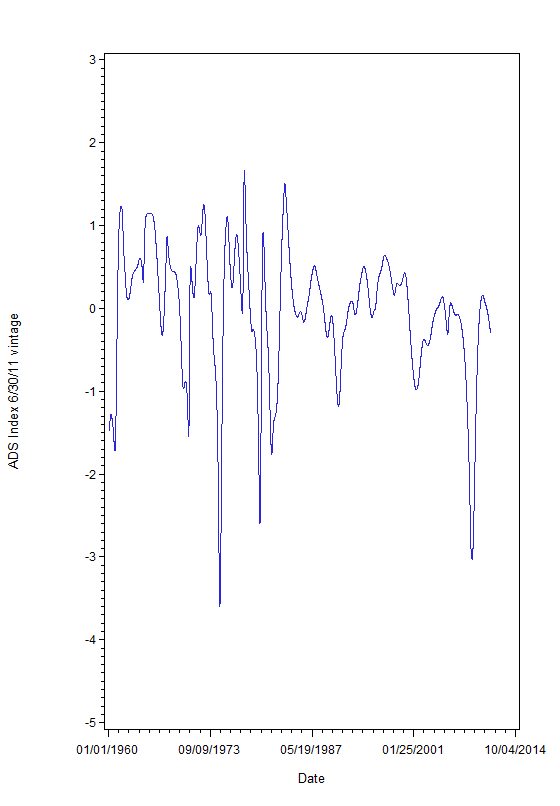
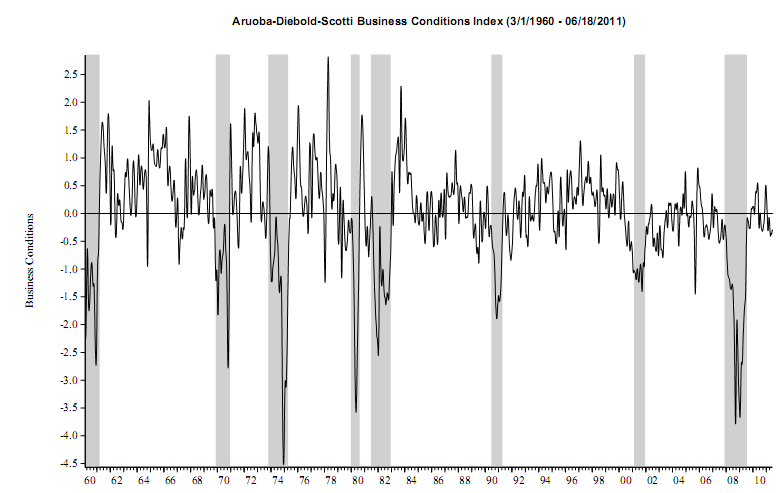
Are the good old days really gone? If the Aruoba-Diebold-Scotti Index is right, then even the 90s dot-com boom and the post-2001 recovery years were not as good as the post-1980 recovery years (or even the 60s and the 70s for that matter).


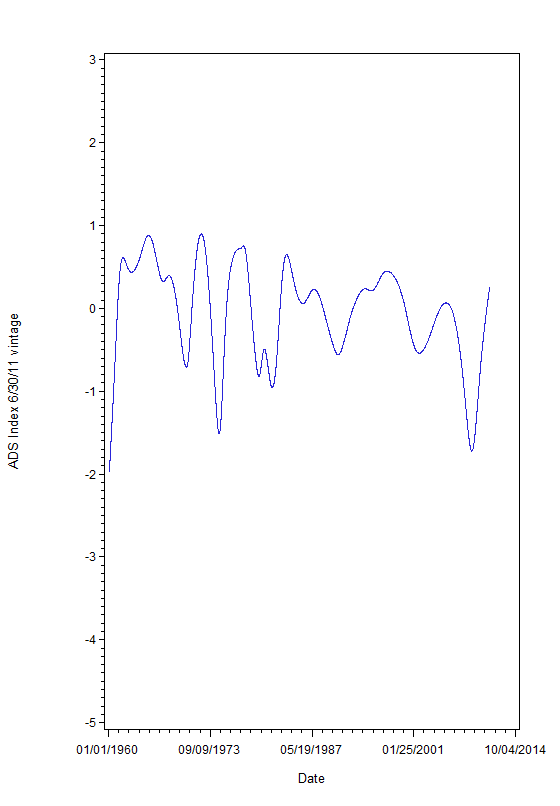
My ocular regression is confirmed by this following parametric smoothed plot:


Of course, the smoothing parameter was picked to confirm my bias. The following plots use different smoothing parameters.

Friday, July 1, 2011

What does democracy need

The Arab Spring has spawned some discussion on the foundations of democracy.

Rashid Khalidid,Edward Said Professor of Modern Arab Studies on whether democracy needs leaders:

I can’t talk to a journalist, American or Arab, without being asked, “Where are the leaders?” The activist and journalist Nawara Negm, a wonderful young woman who is one of the organizers in Egypt, as far as one knows, was asked about this. She said, “The age of zaims is over.” Zaim means “strongman.”

The Middle East had that. There was the shah in Iran, Abdel Nasser in Egypt, Hussein in Iraq. That model decisively failed. Mubarak is the last in the line of such zaims. At least we hope he was the last. I don’t think that the kind of society that’s thrown up this movement is going to tolerate another zaim, and I think this society has moved beyond that, at least in the case of Egypt. That doesn’t mean that such a system may not be imposed, but that is a recipe for instability and it wouldn’t last.

The Egyptians have shaken off a lot. They have not yet succeeded in finally and fundamentally making a lot of changes, but one of the things that they have changed is the sense that you need a supreme leader.

I’m a historian; I’m never happy predicting the future. I don’t see the Ataturk model. But if you say to me the Turkish model, with a military that eventually ceases to intervene in public life; with an evolution of a secular system, which can incorporate religious parties; with a greater and greater degree of democracy, which is what the Turkish model so far represents, that I can see. That has a lot of appeal in the Arab world, partly because Turkey is a little bit like the Arab societies, partly because it is so successful. It is a model in multiple spheres, not least of which is the constitutional and political, but also the economic and the cultural. At the same time, Turkey is a modern society. And it’s rich. There is humongous Turkish investment in Syria, Lebanon, Jordan, Iraq, Egypt, and North Africa.

Timur Kuran:

A stronger civil society alone will not bring about democracy. After all, private organizations can promote illiberal and despotic agendas, as Islamist organizations that denounce political pluralism and personal freedoms demonstrate. But without a strong civil society, dictators will never yield power, except in the face of foreign intervention.

Independent and well-financed private organizations are thus essential to the success of democratic transitions. They are also critical to maintaining democracies, once they have emerged. Indeed, without strong private players willing and able to resist undemocratic forces, nascent Arab democracies could easily slip back into authoritarianism.