In Penang at the Queensbay mall which was where we were in late July/early August.
According to Wikipedia:
… there are still international Borders stores operating in The United Arab Emirates, Oman, Malaysia and New Zealand. These Borders stores are now under different ownership from the original Borders Group, and were unaffected by their store closures.
Citation sorely needed.
Tuesday, August 28, 2012


Monday, August 27, 2012
Malaise
This has been affecting me almost all summer. Will have to try to get back into some posting asap.
Monday, July 16, 2012
Some of my readings
- Alan Greenspan, Age of Turbulence - disappointing. Mostly I was trying to learn something behind his thinking when he looks at numbers. Except for the instance when he was describing the lack of productivity gains from the Internet (which I’m dubious there ever was any) there was very little to be gained from this book.
- Gary Katzenstein, Funny Business - illustrates how naive an American can be when he is accepted into an internship at Sony. It is a hilarious look at his life in Japan for the short time he was there. It is a story of cultural differences and at times illustrates the ugliness of Americans abroad. He is able to laugh at his own follies which I think is what made this book a fairly breezy read.
- Peter Lynch, One Up on Wall Street was so self-effacing that I wondered how Peter Lynch ever made any money.
- John Perkins, Confessions of an Economic Hit Man - appealed to the conspiracy theorist in me but at the end I had to confess that it all sounded just a little too wild.
- FM Scherer, International High Technology Competition was a little disappointing. I’m not particularly sure what I had expected but the most interesting parts were definitely the narrative portions of how US industries responded to foreign competition in the high-technology sector. The responses were categorized into “aggressive”, “submissive”, “business-as-usual” as well as the outcomes from these responses. Of particular interest was whether firms increased, cut back or did nothing in terms of R&D expenses. The regression analyses can be considered exploratory since there weren’t really any strong conclusions that could be drawn from them (at least from my point of view). This was mainly because there didn’t seem to be real strong patterns in how firms responded although nationality/international experience of managers seem to be an important factor.
- Arnold Danielson, Consolidation of Banking, or How Five Banks Bought 50% of America's Biggest Business - this book was outdated the moment it was published since the financial crisis of 2007 came in the heels of its release. For someone with little knowledge of the US banking industry this was a good introduction to how inter-state regulation of banking led to the creation of the bank conglomerates that stood just before the subprime mess. The story continues to unfold however.
- Mario Livio, The Equation that Couldn’t Be Solved was enjoyable and a good introduction to the lives of Evariste Galois and Niels Abel. It was a little too much to expect the book to teach me about symmetry and group theory however. The question of symmetry seems to be the heart of quantum physics today but it was not handled very well for a novice like myself. Like many pop science books the explanations were forgotten after the last page.
Sunday, July 15, 2012
Reliability of electricity
Last week we were out in Edinburg/Woodstock area near the Shenandoah Mountains. As is sometimes the case, we came across a bulletin board outside a realtor’s office and looked at what was available for sale in the area.
I was a little surprised to see a home for sale with a whole house generator. These have become quite popular in recent years with an increasingly (and seemingly) unreliable power grid. I was surprised for several reasons:
Most disturbing was the sense that perhaps electricity has become much more unreliable in recent years. Unfortunately, there appears to be no good data on the reliability of the electric grid. Scientific American reports based on an MIT report:
“Data on outages are neither comprehensive nor consistent, however. Most outages occur within distribution systems, but only 35 U.S. States require utilities to report data on [distribution outages]… it is accordingly impossible to make comprehensive comparisons across space or over time.”
The World Bank carries out surveys of electricity outages and its effects on manufacturing industries but the US is a non-respondent. A backup power supplier, Eaton has a report of blackouts in the United States (register for download) but only has data for 3 years which makes it hard to detect a trend.
More promising are reports from LBL, in particular this and this. From the latter, is the conclusion of a study in January 2012:
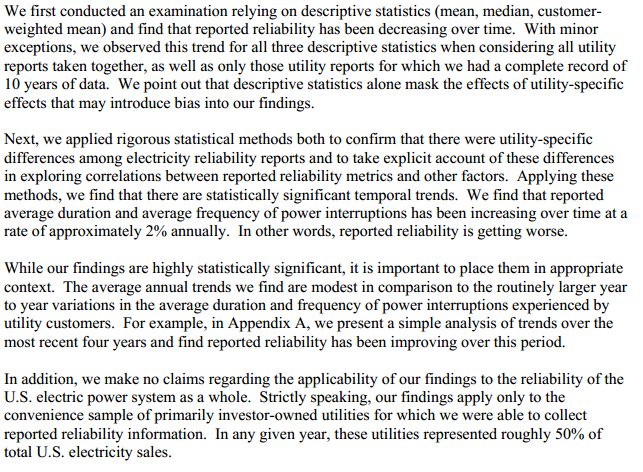
In other words, we still don’t know what we don’t know.
I was a little surprised to see a home for sale with a whole house generator. These have become quite popular in recent years with an increasingly (and seemingly) unreliable power grid. I was surprised for several reasons:
- I expected more homes in rural areas to be more off the grid than most, i.e. propane for heating and perhaps for running electricity, septic tank, well water, etc.
- I expected people from rural Virginia to be hardier than Washingtonians (then again, perhaps the seller was a Washington transplant - or perhaps I have a misplaced bias)
- I expected that dense cities were more vulnerable in terms of length of outage and people affected than rural Virginia. The flip side is that the more rural you are the less likely that restoration will be quicker since utilities tend to emphasize fixes that put the most people back online as soon as possible.
Most disturbing was the sense that perhaps electricity has become much more unreliable in recent years. Unfortunately, there appears to be no good data on the reliability of the electric grid. Scientific American reports based on an MIT report:
“Data on outages are neither comprehensive nor consistent, however. Most outages occur within distribution systems, but only 35 U.S. States require utilities to report data on [distribution outages]… it is accordingly impossible to make comprehensive comparisons across space or over time.”
The World Bank carries out surveys of electricity outages and its effects on manufacturing industries but the US is a non-respondent. A backup power supplier, Eaton has a report of blackouts in the United States (register for download) but only has data for 3 years which makes it hard to detect a trend.
More promising are reports from LBL, in particular this and this. From the latter, is the conclusion of a study in January 2012:
In other words, we still don’t know what we don’t know.
Friday, July 6, 2012
Kiasu again
From NGM:
If there is a single word that sums up the Singaporean existential condition, it is kiasu, a term that means "afraid to lose." In a society that begins tracking its students into test-based groups at age ten ("special" and "express" are the top tiers; "normal" is the path for those headed for factory and service-sector work), kiasu seeps in early, eventually germinating in brilliant engineering students and phallic high-rises with a Bulgari store on the ground floor. Singaporeans are big on being number one in everything, but in a kiasu world, winning is never completely sweet, carrying with it the dread of ceasing to win. When the Singapore port, the busiest container hub in the world, slipped behind Shanghai in 2005 in total cargo tonnage handled, it was a national calamity.
The word has made it into the dictionary and has even become a dish:
… kiasu is a noun and adjective from the Chinese Hokkien dialect, meaning "extreme fear of losing, or of being second best". It's a notion the neurotically ambitious Singaporean and Malaysian professional middle classes regard as so self-defining that their sitcom character Mr Kiasu is a similar emblem of endearingly gruesome national character as Mr Brent is to us.
Having made its way to the Singapore-English hybrid tongue called Singlish, kiasu completed its trek across the etymological world in March when the Oxford English Dictionary included it on its quarterly list of new words, thereby qualifying it for Call My Bluff.
But enough of the linguistics and on to today's restaurant, which by way of an exquisite red herring worthy of Gogol happens to be called Kiasu. And which, by way of an enchanting irony worthy of a writer begging for the sack, need have no fear of being second best itself.
And on Singlish (again from the NGM):
… the government has maintained a campaign against the use of "Singlish," the multiculti gumbo of Malay, Hokkien Chinese, Tamil, and English street patois that is Singapore's great linguistic achievement. As you sit in a Starbucks listening to teens saying things like "You blur like sotong, lah!" (roughly, "You're dumber than squid, man!"), Singlish seems a brilliantly subversive attack on the very conformity the government claims it is trying to overcome. Then again, one of Singlish's major conceits is the ironic lionization of the flashy, down-market "Ah Beng" culture of Chinese immigrant thugs and their sunglass-wearing Malay counterparts.
A previous post here.
If there is a single word that sums up the Singaporean existential condition, it is kiasu, a term that means "afraid to lose." In a society that begins tracking its students into test-based groups at age ten ("special" and "express" are the top tiers; "normal" is the path for those headed for factory and service-sector work), kiasu seeps in early, eventually germinating in brilliant engineering students and phallic high-rises with a Bulgari store on the ground floor. Singaporeans are big on being number one in everything, but in a kiasu world, winning is never completely sweet, carrying with it the dread of ceasing to win. When the Singapore port, the busiest container hub in the world, slipped behind Shanghai in 2005 in total cargo tonnage handled, it was a national calamity.
The word has made it into the dictionary and has even become a dish:
… kiasu is a noun and adjective from the Chinese Hokkien dialect, meaning "extreme fear of losing, or of being second best". It's a notion the neurotically ambitious Singaporean and Malaysian professional middle classes regard as so self-defining that their sitcom character Mr Kiasu is a similar emblem of endearingly gruesome national character as Mr Brent is to us.
Having made its way to the Singapore-English hybrid tongue called Singlish, kiasu completed its trek across the etymological world in March when the Oxford English Dictionary included it on its quarterly list of new words, thereby qualifying it for Call My Bluff.
But enough of the linguistics and on to today's restaurant, which by way of an exquisite red herring worthy of Gogol happens to be called Kiasu. And which, by way of an enchanting irony worthy of a writer begging for the sack, need have no fear of being second best itself.
And on Singlish (again from the NGM):
… the government has maintained a campaign against the use of "Singlish," the multiculti gumbo of Malay, Hokkien Chinese, Tamil, and English street patois that is Singapore's great linguistic achievement. As you sit in a Starbucks listening to teens saying things like "You blur like sotong, lah!" (roughly, "You're dumber than squid, man!"), Singlish seems a brilliantly subversive attack on the very conformity the government claims it is trying to overcome. Then again, one of Singlish's major conceits is the ironic lionization of the flashy, down-market "Ah Beng" culture of Chinese immigrant thugs and their sunglass-wearing Malay counterparts.
A previous post here.
Lying heroes
Two years ago K1’s unit of study was ‘Heroes’ and one of the books they read was Greg Mortensen’s Three Cups of Tea. At the end of the school term, it was revealed that almost all of the book was a figment of the author’s hyper imaginative mind. Or did he succumb to all the things that he thought he was?
On page 129, Mortensen quotes Edmund Hillary:
But I’ve learned through the years, as long as you don’t believe all the rubbish about yourself, you can’t come to too much harm.
In retrospect, the fallout from Mortensen’s Central Asia Institute was almost inevitable. The board could not get him to account for anything and his coauthor David Oliver Relin remarked about how difficult it was to work with Mortensen (pg. 229).
At the end of the term the teacher spoke about the CBS ‘60 Minutes’ expose to the class. My sense was that universally the kids felt betrayed although this was not the word they used. The most important lesson I think they learned from this was that “Anybody can lie” and “Don’t believe everything you read”. In may ways I saw this an almost transformative experience as they shifted from 6th to 7th grade that year. And perhaps it’s a good thing to learn early and together as a class that lying is leads to distrust.
The time for arithmetic and poetry is past. Nowadays, my brothers, take your lessons from the Kalashnikov and rocket propelled grenade
- graffiti spray painted on the courtyard wall of the Korphe school.
On page 129, Mortensen quotes Edmund Hillary:
But I’ve learned through the years, as long as you don’t believe all the rubbish about yourself, you can’t come to too much harm.
In retrospect, the fallout from Mortensen’s Central Asia Institute was almost inevitable. The board could not get him to account for anything and his coauthor David Oliver Relin remarked about how difficult it was to work with Mortensen (pg. 229).
At the end of the term the teacher spoke about the CBS ‘60 Minutes’ expose to the class. My sense was that universally the kids felt betrayed although this was not the word they used. The most important lesson I think they learned from this was that “Anybody can lie” and “Don’t believe everything you read”. In may ways I saw this an almost transformative experience as they shifted from 6th to 7th grade that year. And perhaps it’s a good thing to learn early and together as a class that lying is leads to distrust.
The time for arithmetic and poetry is past. Nowadays, my brothers, take your lessons from the Kalashnikov and rocket propelled grenade
- graffiti spray painted on the courtyard wall of the Korphe school.
Thursday, July 5, 2012
Take your children to work day
No, it's not today but I've been thinking.... We have been watching some old movies with the kids: Sound of Music, Mary Poppins, etc. and we have been enjoying the bonus features of how the movies were made. It would have made for one very exciting take your children to work day if they could see all the work that goes into it.
Given that many of us now work in offices I gather that take your children to work day must be pretty boring (for the kids anyway). Take what Anne-Marie Slaughter considers exciting and rewarding:
In between, the days were crammed with meetings, and when the meetings stopped, the writing work began—a never-ending stream of memos, reports, and comments on other people’s drafts.
Well, maybe not this aspect of it but one can’t help but think that she misses it.
Given that many of us now work in offices I gather that take your children to work day must be pretty boring (for the kids anyway). Take what Anne-Marie Slaughter considers exciting and rewarding:
In between, the days were crammed with meetings, and when the meetings stopped, the writing work began—a never-ending stream of memos, reports, and comments on other people’s drafts.
Well, maybe not this aspect of it but one can’t help but think that she misses it.
Subscribe to:
Posts (Atom)