Thursday, October 10, 2013

Airports and travel


This post on airport security reminds me of how nervous I get every time I reenter the United States:
I recently asked my young son whether he thought he could travel by himself to visit his grandmother in Victoria, Canada. He said that he could navigate the airports fine and getting into Canada was no problem but he was afraid of the security people coming back into the United States. Bear in mind that my son is American.

It's not just the US. I'm also nervous reentering Malaysia. Our various hops through airports in the Middle East this year and last year also convinced me that while going through security makes me nervous even when I have had some past experience with them, the ones in the Middle East had me quaking.

Put it down perhaps to some irrational fear of people with authority - in this case absolute authority in deciding whether I am allowed to enter their country. Also perhaps check one off for uncertainty - uncertainty on how uniformly laws are going to be enforced or not enforced. Another check for the natural tendency for those in authority to behave capriciously.

Things had been getting better in the US - CIS were actually friendly for a time - and then 9/11 pretty much turned things around. Capriciousness is something that makes our transformation into a surveillance state (and this is happening everywhere) something to be afraid about. One way the US can head is towards an atmosphere of a surveillance state on par with the Middle East. The sign that this is happening is this:

Its not difficult to imagine searches expanding to items other than electronics.

And this post on the price of visas only reminded me of our previous visa travails and the capriciousness of visa approvals.

Gravity

While the population of this earth is consumed with interest in the movie, with who is saying what about the realism of the movie I have just discovered a rather unexplored (in my part of the world) aspect of gravity.

Recently while browsing on the web (or maybe it was Amazon) I came across something called a periodic table of beer styles. The picture below is from here.


As if that were not cool enough, note the KEY at the bottom left hand corner which led me to the exploration of beer gravity. Here's the Wikipedia entry (which was noted as being too technical although I have seen some that are even more so):
Gravity, in the context of fermenting alcoholic beverages, refers to the specific gravity, or relative density compared to water, of the wort or must at various stages in the fermentation. The concept is used in brewing and wine making industry. Specific gravity is measured by a hydrometer, refractometer, pycnometer or oscillating U-tube electronic meter.
The density of a wort is largely dependent on the sugar content of the wort. During alcohol fermentation, yeast converts sugars into carbon dioxide and alcohol. The decline in the sugar content and the presence of ethanol (which is appreciably less dense than water) drop the density of the wort. The percentage of alcohol can be calculated from the difference between the original gravity (abbreviated OG) of the wort and the current specific gravity (abbreviated SG) of wort. By monitoring the decline in SG over time the brewer obtains information about the health and progress of the fermentation and determines that it is complete when gravity stops declining. If the fermentation is finished, the specific gravity is called the final gravity (abbreviated FG). For example, for a typical strength beer, OG could be 1.050 and FG could be 1.010.
A more friendly descriptive style is here:
... what brewers mean by gravity is simply the density of the wort compared to water. The full low-down on wort is beyond the scope of this post and will be discussed one day. For now it’s safe to understand that wort is unfermented beer. Another important bit about wort is that it’s full of sugar and when the wort starts fermenting (changing into beer) that sugar gets eaten and turned into alcohol (and some other stuff).

As I said before, gravity is the density of the wort compared to water and this is measured in comparison to water. So the density of water is 1.000 and the density of a wort may be 1.050, meaning the wort has 50 degrees of excess gravity and the beer has an original gravity of 50.

Once we’ve got the measurement of original gravity we can add yeast which starts the fermentation process. The yeast begins eating the sugar which makes alcohol (woo hoo) and carbon dioxide. Eating away at the sugar also makes everything less dense, thus lowering the gravity. Once most of the sugar has been eaten this means fermentation is done and you can now get the final gravity.

The original gravity was just the density of the wort compared to the water and so the final gravity is the density of beer compared to water. So we went from 1.050 down to something like 1.011, or a final gravity of 11. The difference in these two numbers plus some complex algebra, which I’m not getting into, is how brewers determine the alcohol by volume of a beer. The bigger the difference in original vs. final gravity means the stronger the beer. Which is why really strong beers are sometimes referred to as high gravity beers.

Another facet on the impact of gravity is that very different styles of beer can start at the same original gravity but can differ drastically in their finishing gravity. A high finishing gravity makes for a sweeter, maltier taste. A lower finishing gravity makes for a drier beer.
(emphasis are mine)

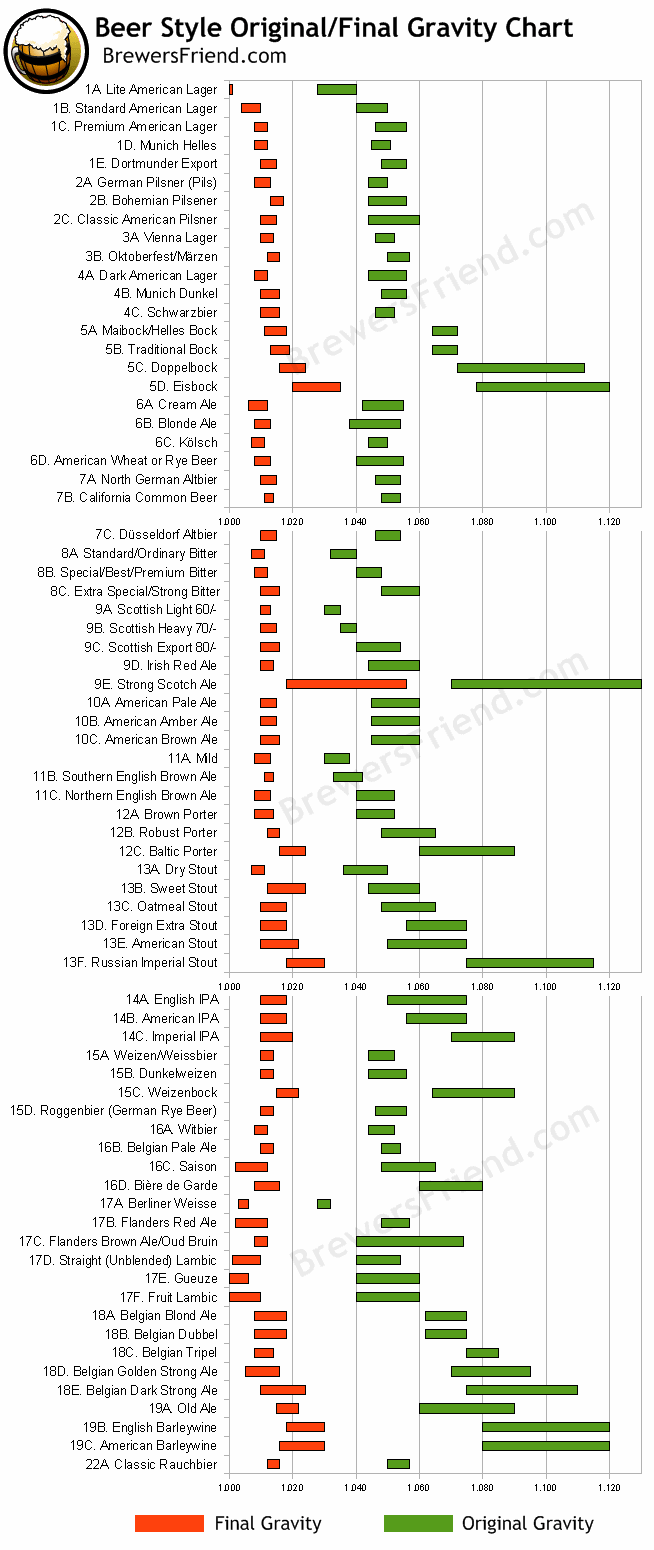
And here are some original vs. final gravity comparisons of different beers:

beer style gravity chart

Wednesday, October 9, 2013

Degrees of knowledge

The recent announcement of the winners for the Nobel Prize in Physics reminded me of this post on the status of "junk" DNA where the author obliquely compares economics to genetics and physics:
Economists are sometimes chided for disagreeing about the importance of such basic questions as the relative role of aggregate demand and aggregate supply but physicists can’t even find most of the universe and microbiologists don’t agree on whether the human genome is 80% functional or 80% junk. Is disagreement a result of knaves and fools? Sometimes, but more often disagreement is just the way the invisible hand of science works.
In one of my more sensitive (i.e. irritable) moments I leaped to the conclusion that the author was tying to put economics on the same pedestal as genetics and physics. After all, if physics and genetics can only know 5% and 20% respectively of their fields are these fields any more scientific than economics?

Pshaw, and I am probably arguing against a straw man here - but since I'm getting old and grouchy I'll just go ahead and pile into the straw man. Economics is nowhere near physics and in physics the proof is in its ability to predict the existence and characteristics of particles at the quantum level. At a more aggregate level consider Einstein's prediction on the orbit of Mercury based on GR. There is NOTHING even close in economics that can make any statement with such quantitative accuracy. At the most economics can say that on one hand stock prices will go up or on the other it might go down and if he had three hands he might even through in unchanged as another option. Macroeconomics has vacillated from one fad to another (New Keynesian, classical revival, real business cycles -- you name it) without ever coming close to even having a decent understanding of the economy.* If you don't believe this statement then ask yourself whether an increase in government spending will increase aggregate demand and what are its quantitative effects.

The debate on junk DNA will continue as will the definition of its "function" but one measure of science is the amount of knowledge that is gained as scientists continue to peel back the layers. No doubt in physics, the question already being studied is "what generates this Higgs field" whereas in economics, the process is more like "er, er, er, hmm... on one hand...".

*One possible advancement in economics is in auctions and the evidence is in the success of the FTC auction of the spectrum. However, my reading of the implementation of the auctions in the US and UK lead me to conclude that at best it is still an inexact science. (After all, we aren't dealing with particles, we're dealing with people, which is the famous economists' excuse for knowing very little.)

Debt limit timeline

This was a good presentation on the implications of the debt limit:

http://www.washingtonpost.com/blogs/wonkblog/files/2013/10/payments1.jpg
There's been a fair bit of confusion about the timeline for the debt-ceiling crisis. The date Oct. 17 gets tossed around a fair bit as a hard deadline. But that's probably not the date when we'll see lots of financial disruptions if Congress fails to lift the debt ceiling.
The real crises are likely to occur a little later in October or early November. But even that's not certain.

And from the Center of Bipartisan Policy from which the above article was based:

When is the debt limit X Date?

Debt rollover and the X Date

Tuesday, October 8, 2013

Shutdown optics?

 
 This chart has been making its rounds on the Internet - I added the S&P500 to the VIX volatility index. The claim is that the shutdown is a non-story and is all optics and theater since the government could never credibly threaten to default no matter who is in charge:
“As political theater,” he said, “the debt ceiling is not a useful threat, because politicians are basically threatening to shoot themselves, as they will rightly shoulder the blame for the serious global economic consequences of a default.”
Mr. Reinhart’s view has become conventional wisdom on Wall Street when it comes to whether the country will hit the debt ceiling limit on Oct. 17. Warren Buffett put it this way: “We’ll go right up to the point of extreme idiocy, but we won’t cross it.”
This assumes that Congress or rather the Tea Party 30 are rational. What about the Lehman failure? Was the market expecting that?

Update (10/9/2013) from NYT:

Many in G.O.P. Offer Theory: Default Wouldn’t Be That Bad

On Wall Street, among business leaders and in a vast majority of university economics departments, the threat of significant instability resulting from a debt default is not in question. But a lot of Republicans simply do not believe it.
A surprisingly broad section of the Republican Party is convinced that a threat once taken as economic fact may not exist — or at least may not be so serious. Some question the Treasury’s drop-dead deadline of Oct. 17. Some government services might have to be curtailed, they concede. “But I think the real date, candidly, the date that’s highly problematic for our nation, is Nov. 1,” said Senator Bob Corker, Republican of Tennessee. 

Others say there is no deadline at all — that daily tax receipts would be more than enough to pay off Treasury bonds as they come due. 

“It really is irresponsible of the president to try to scare the markets,” said Senator Rand Paul, Republican of Kentucky. “If you don’t raise your debt ceiling, all you’re saying is, ‘We’re going to be balancing our budget.’ So if you put it in those terms, all these scary terms of, ‘Oh my goodness, the world’s going to end’ — if we balance the budget, the world’s going to end? Why don’t we spend what comes in?” 

“If you propose it that way,” he said of not raising the debt limit, “the American public will say that sounds like a pretty reasonable idea.” 

Is it time to be afraid?

Update 10/11/2013: Even Marty Feldstein (and by extension Greg Mankiw) doesn't believe that default is a risk if the debt limit is not raised.