Is there a natural tendency (some more than others) to stick it to the man, whomever this might be? This week/month, ‘the man’ happens to be Google, and for all its transgressions in the past and all it plans to commit in the future I’ve decided to switch my home page from Google to Bing. Ironically, 10 years ago I probably would have designated Microsoft to be ‘the man’.
Showing posts with label Googling. Show all posts
Showing posts with label Googling. Show all posts
Tuesday, January 31, 2012

Thursday, January 19, 2012
Vado a bordo, cazzo
Vado a bordo, cazzo: I could not resist typing this into Google Translate: “I go on board, fucking”. The alternatives (click on the words and Google will pop up some alternatives) may be a little better, e.g. “I go on board, dick”, etc. but none seem to be able to drop the pronoun.
Friday, September 10, 2010
Penang as a tourist destination
I've been pondering why Penang remains a tourist destination – it used to be the beaches and it certainly isn't that any more. For a while now (apparently unknown to me), it has been street food and staying at Gurney Drive made me aware of this. Every evening tour buses would disgorge hordes of tourists to the end of Gurney Drive at the roundabout to Tanjung Tokong and they would descend upon the food stalls near our apartment.
We tried the food there one night – it wasn't all good – mostly miss than hit and the stalls didn't look particularly appetizing.
What used to be knowledge by word of mouth – where the best char koay teow was, etc. has now been formalized into guide books for foods as well as top ten lists in newspapers. I discovered all this on this particular trip and was slightly overwhelmed at how much things have changed. Of course, the Internet has been playing a big role as well. Try googling 'penang street food' and all kinds of web sites and blogs complete with mouth watering pictures of dishes appear.
Penangites (and its tourists) are apparently undeterred by the effect of emissions on the environment where food is concerned. They are willing to drive miles out of the way in search of the best hokkien mee or whatever seems to be on their mind.
We tried the food there one night – it wasn't all good – mostly miss than hit and the stalls didn't look particularly appetizing.
What used to be knowledge by word of mouth – where the best char koay teow was, etc. has now been formalized into guide books for foods as well as top ten lists in newspapers. I discovered all this on this particular trip and was slightly overwhelmed at how much things have changed. Of course, the Internet has been playing a big role as well. Try googling 'penang street food' and all kinds of web sites and blogs complete with mouth watering pictures of dishes appear.
Penangites (and its tourists) are apparently undeterred by the effect of emissions on the environment where food is concerned. They are willing to drive miles out of the way in search of the best hokkien mee or whatever seems to be on their mind.
Wireless access frustration
Why is it that when I try to log onto an unsecured wireless network, all the internet adapter does is cycle through the channels without connecting to the Internet? Having Googled this problem it is clear that I am not the only one with the problem (and none of the proposed solutions that I could affect worked). The network shows up as an available network. The adapter is a Netgear external card. When I try it with the internal Broadcom adapter, the network doesn't even show up. What is even more interesting is that M's laptop running Windows Vista has no problem connecting to the network. (I'm running XP and we're connecting to the hotel's wireless network.) Tried updating the firmware and drivers but that didn't produce the desired effect.
This happened to me in Bangkok and I ended up buying another network adapter which worked fine.
Update: When I got back to the US I tried the Netgear adapter and it worked fine as well so I have no idea what the problem could have been.
Tuesday, May 4, 2010
Tranche
Andrew Gelman wonders why "fancy" financial products use the word "tranche" rather than slice. I suspected the reason was historical - perhaps related to loan tranches by the IMF post Bretton Woods. Thus, I was surprised when a Google News Search using "loan" and "tranche" turned up entries as early as 1930 referring to the Dawes Plan which was an attempt by the Triple Entente (basically Great Britain, France and Russia) to collect war reparations from Germany.


The use of tranches for securities came later. The search for "security" and "tranche" gave results as early as 1980.
Tuesday, February 2, 2010
Jerking my knee
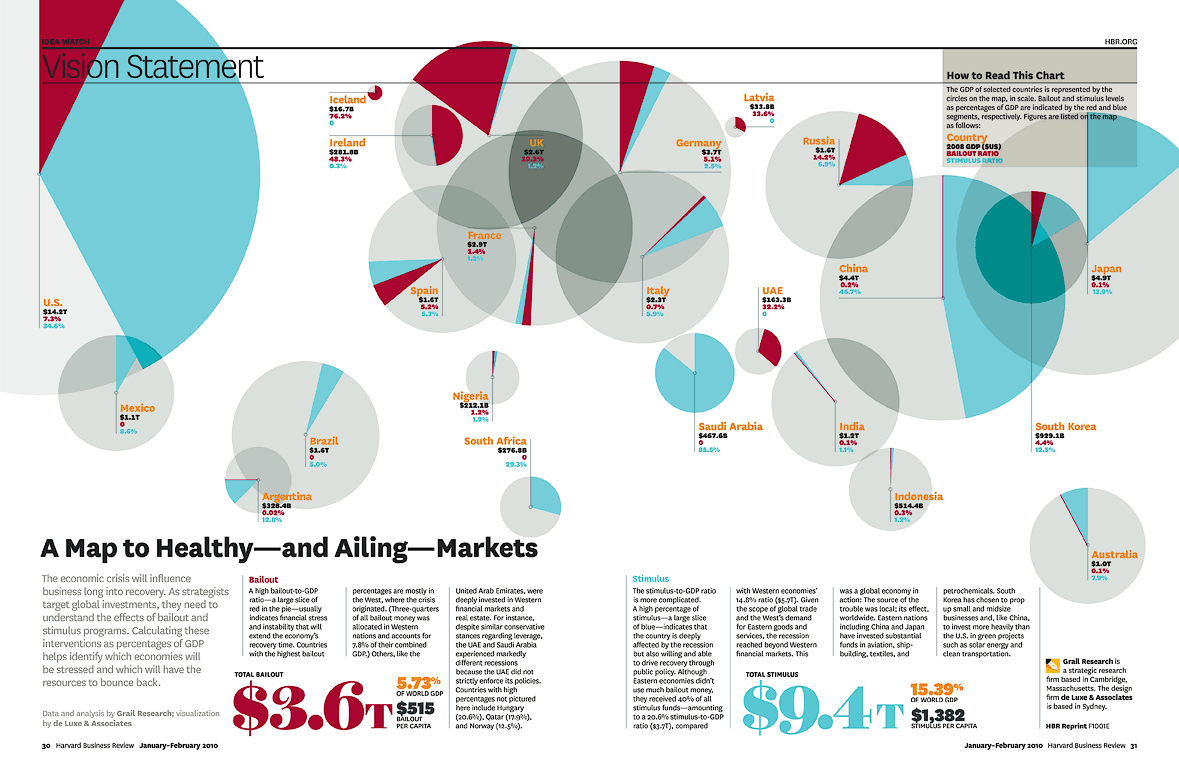 I had a knee jerk reaction when I saw this link on MR which was listed as Which country showed the most spending restraint during the financial meltdown?
It showed bailout money as a percent of GDP and that the U.S. was the largest while France was the smallest. The link to it was titled When Sh*t Hit The Fan, France Stuck To Its Ideals While The U.S. And U.K. Became Socialist Monsters.
My knee jerk reaction was duh! The graphic shows nothing. A country like France with larger government spending the either the U.S. or U.K. would be more constrained in being able to spend more. Duh!
On more careful reflection my reaction is the same. Only this time, a more careful examination resulted.
1. Bailout/stimulus spending really should be as a percent of GDP as already depicted but also government spending should be a percent of GDP and also be depicted and thus a more instructive graphic could be ratio of total government spending (including bailout/stimulus) to GDP.
2. Some googling brought me to the following link which tabulates government spending as a percentage of GDP. France is 7th at 61.1 while U.S. and U.K are 19.9 and 50.0 respectively(ranked at 50th and 37th). So the hypothesis that France is more constrained bears out.
3. More googling lead me to believe that perhaps the numbers above aren't correct. This link has U.S. government spending at 46 percent. Another MR link also has U.S. spending at roughly 40 percent. Calculations using FRED data series FGCEA and GDP is roughly 9 percent (1,200/14,000). The CBO numbers seem to be in accord with #2 however, while here NIPA numbers show it to be around 35%. So perhaps it's all a matter of definition.
4. Which leads back to the graphic which isn't clear at all as to what constitutes stimulus and bailout spending. Do I really believe that Nigeria tracks bailout and stimulus spending separately?
Wednesday, August 19, 2009
Selling magazines door to door for charity
We had two cases in one week - one was a mom trying to raise money for their soccer club and another to help the troops. After "subscribing" to this several times over the course of 5 years (e.g. to raise money for college, to help kids get a fresh start) I finally decided to check it out which validated what I've always suspected. This is nothing more than a scam. A scan of google searches came up with these:
1. Coal Run Police Chief Todd Akers says people are claiming they are selling magazine subscriptions for a charity or a college, but he says their stories do not check out.
He says no local charities or colleges say they are selling magazine subscriptions.
2. Yes, some of the sellers are hardened dyed in the wool con artists with criminal records, but you may also want to keep in mind that an increasing number of the sellers are innocent people who have gotten trapped into this form of modern day indentured servitude/youth exploitation by unscrupulous "recruiters". Some of the sellers may be as young as 14, but are telling people they are 18.
3. Traveling Sales Crews via Absolute Write.
From the latter link:
The kids who just came to my door (all adorable wide-eyed smiles when trying to hook me, and abusive and cursing when I politely turned them down) were from American Community Services, Inc., but there are many such organizations that function like gangs and ensnare kids into a truly horrible lifestyle.
4. In Seattle, WA: If a young person knocks on your door and says they're selling magazines for a charity, wait before reaching for your pocketbook. Fresh Start Opportunities claims that money from the subscriptions will be used to help young people get a “fresh start on life,” but the company isn’t a registered charity. ... Solicitors represent that the purchase of subscriptions will help young people get off the street and back on their feet so they can earn money to go to school. ... A 19-year-old man working for Fresh Start Opportunities was arrested in October after he allegedly broke into an Edmonds home, attacked the owner and stole her purse. The man was also a suspect in burglaries in Sammamish and Tumwater. Fresh Start Opportunities employees have also been linked to California thefts.
What if these "sales people" are also using this as a pretext to see how vulnerable a home is to burglary?
Perhaps not answering the door is the best option.
1. Coal Run Police Chief Todd Akers says people are claiming they are selling magazine subscriptions for a charity or a college, but he says their stories do not check out.
He says no local charities or colleges say they are selling magazine subscriptions.
2. Yes, some of the sellers are hardened dyed in the wool con artists with criminal records, but you may also want to keep in mind that an increasing number of the sellers are innocent people who have gotten trapped into this form of modern day indentured servitude/youth exploitation by unscrupulous "recruiters". Some of the sellers may be as young as 14, but are telling people they are 18.
3. Traveling Sales Crews via Absolute Write.
From the latter link:
The kids who just came to my door (all adorable wide-eyed smiles when trying to hook me, and abusive and cursing when I politely turned them down) were from American Community Services, Inc., but there are many such organizations that function like gangs and ensnare kids into a truly horrible lifestyle.
4. In Seattle, WA: If a young person knocks on your door and says they're selling magazines for a charity, wait before reaching for your pocketbook. Fresh Start Opportunities claims that money from the subscriptions will be used to help young people get a “fresh start on life,” but the company isn’t a registered charity. ... Solicitors represent that the purchase of subscriptions will help young people get off the street and back on their feet so they can earn money to go to school. ... A 19-year-old man working for Fresh Start Opportunities was arrested in October after he allegedly broke into an Edmonds home, attacked the owner and stole her purse. The man was also a suspect in burglaries in Sammamish and Tumwater. Fresh Start Opportunities employees have also been linked to California thefts.
What if these "sales people" are also using this as a pretext to see how vulnerable a home is to burglary?
Perhaps not answering the door is the best option.
Tuesday, January 27, 2009
Google, stupid, reading, writing
This article in the Atlantic "Is Google Making Us Stupid" resulted in a lot of random thoughts:
1. The ability to quickly search and scan items I find makes it less likely that I will concentrate for a long article. Then again the sheer number of links sometimes makes it joyful to jump from page to page. (I like IMDB for this.)
2. Reading on screen is hard, especially academic articles where I like to skip pages or move back and forth through them. Perhaps there is a reading software (that reads PDF) that allows me "rip" pages off and set them aside to look at them later.
3. The same issue of the Atlantic has an article on Rupert Murdoch's purchase of WSJ and the future of print newspapers in general. It made me think that with shortened attention spans the future is not in dailies but perhaps in weeklies or twice weeklies (unless there is real breaking news). Dailies will be the similar to the Washington Post Express but the more substantially weeklies will provide the detail. Alternatively, the online versions will provide more detail. One random thought is here.
The problem is declining ad revenue and subscriptions (and costs). The above addresses the print costs of dailies. Ad revenue could potentially be boosted with the free express versions and subscription could increase if I didn't have to deal with newspapers piling up to be read. (For instance, I did not get to my July/Aug issue of Atlantic until just recently.) Unfortunately, this approach threatens the business of Time/Newsweek but the styles could be different enough that there is some differentiation.
4. The short attention span also translates to writing. Without a word processor it seems that I am unwilling to write using a pencil/pen and paper. Andrew Gelman explores how different writing software have affected his writing. I am interested in how the medium (electronic etc. affects style and abilities). I for one would like to write more technical articles but the thought of firing up an application to write out equations is enough to make me procrastinate.
After being out of grad school for such a long time I have also seem to lost the ability to use a pencil and paper to work out equations and derivations.
1. The ability to quickly search and scan items I find makes it less likely that I will concentrate for a long article. Then again the sheer number of links sometimes makes it joyful to jump from page to page. (I like IMDB for this.)
2. Reading on screen is hard, especially academic articles where I like to skip pages or move back and forth through them. Perhaps there is a reading software (that reads PDF) that allows me "rip" pages off and set them aside to look at them later.
3. The same issue of the Atlantic has an article on Rupert Murdoch's purchase of WSJ and the future of print newspapers in general. It made me think that with shortened attention spans the future is not in dailies but perhaps in weeklies or twice weeklies (unless there is real breaking news). Dailies will be the similar to the Washington Post Express but the more substantially weeklies will provide the detail. Alternatively, the online versions will provide more detail. One random thought is here.
The problem is declining ad revenue and subscriptions (and costs). The above addresses the print costs of dailies. Ad revenue could potentially be boosted with the free express versions and subscription could increase if I didn't have to deal with newspapers piling up to be read. (For instance, I did not get to my July/Aug issue of Atlantic until just recently.) Unfortunately, this approach threatens the business of Time/Newsweek but the styles could be different enough that there is some differentiation.
4. The short attention span also translates to writing. Without a word processor it seems that I am unwilling to write using a pencil/pen and paper. Andrew Gelman explores how different writing software have affected his writing. I am interested in how the medium (electronic etc. affects style and abilities). I for one would like to write more technical articles but the thought of firing up an application to write out equations is enough to make me procrastinate.
After being out of grad school for such a long time I have also seem to lost the ability to use a pencil and paper to work out equations and derivations.
Wednesday, December 3, 2008
Fragile democracies
The political crisis in Thailand got me thinking about young/fragile/unstable democracies. I haven't spent too much time googling these thoughts so here goes:
Some defintions (or how should we define these terms?):
1. Young - a country that has been democratic but "not for too long of a time".
2. Fragile - a democratic country that shifts back and forth between democracy and autocracy OR a country whose democratic leader is unable to serve out his or her term and has had numerous elections or by-elections to find a new leader.
3. Unstable - a democratic country that has many "events" against the leadership, e.g. strikes, protests, attempted coups.
4. Democratic - any country that holds elections.
Research questions:
1. Are young democracies necessarily fragile/unstable?
2. Are there "old" democracies that are fragile/unstable?
3. Are fragility and instability synonymous?
These concepts don't lend well to quantification or any kind of a cross country analysis which is what I'd like to see. I may have to be content with narratives.
Update: From The Economist, comes charges that the revered king of Thailand ["Father"]constantly intervenes in politics:
Other countries, from Spain to Brazil, have overcome dictatorial pasts to grow into strong democracies whose politics is mostly conducted in parliament, not on the streets. Thailand’s failure to follow suit is partly because “Father” has always been willing to step in and sort things out: his children have never quite had to grow up. The Democrats, the parliamentary opposition, are opportunists, cheering on the PAD while seemingly hoping for another royally approved coup to land the government in their lap.
And I've always wondered if PAD had some implicit royal support since they were never arrested after taking over the airports and they've claimed to be acting in the King's name by carrying his pictures in rallies:
.... The death of one PAD member, apparently blown up in his car by the bomb he was carrying, was quickly buried. But the death of a young woman, reportedly when a police tear-gas canister exploded, became a cause célèbre.
Up to this point there were only whispers as to why the PAD enjoyed such lenient treatment—even from the army, which refused to help the police remove protesters from government offices. However, rumours of an extremely influential backer were confirmed when Queen Sirikit, attended by a clutch of cameramen, presided over the dead woman’s cremation. The king remained silent.
... But the PAD’s ever more menacing behaviour, the palace’s failure to disown it, and the group’s insistence that Thais must choose between loyalty to Mr Thaksin and to the king, may be doing untold damage to the crown itself. Some of Mr Thaksin’s voters must be contemplating the flip-side of the PAD’s argument: if the monarchy is against the leader they keep voting for, maybe it is against them. Such feelings may only be encouraged by the PAD’s condescending arguments that the rural poor, Mr Thaksin’s main support base, are too “uneducated” to have political opinions, so their voting power must be reduced.
And from a commenter (I hope I have the link right):
Thaksin may have been corrupt, although there are a lot more allegations than proofs floating around out there, and media-exaggerated nonsenses - but it's pretty hard to be a top level Thai politician and NOT be corrupt. What I think is that Thaksin was not corrupt enough - he had the insane idea of taking some of Thailand's tax money and spending it on peasants via farm loan writedowns or health care schemes or free public transit, things like that - and that infuriated the older ruling politicians ( who were all (and are) a great deal more corrupt, and openly so, than Thaksin ever thought of being), so, led by this extremely wealthy Sonti who apparently thinks the nation's coffers are his and his cronies personal chequing account, decided Thaksin had to go so the normal order of seriously corrupt politicians milking the nation's treasury could be resumed, and this spending money on the peasants brought to an end. All else followed, and continues following.
Or perhaps he was too corrupt. After his sale of Shin Corp he should have spent more time distributing his wealth among all the other corrupt politicians instead of keeping it all to himself.
Some defintions (or how should we define these terms?):
1. Young - a country that has been democratic but "not for too long of a time".
2. Fragile - a democratic country that shifts back and forth between democracy and autocracy OR a country whose democratic leader is unable to serve out his or her term and has had numerous elections or by-elections to find a new leader.
3. Unstable - a democratic country that has many "events" against the leadership, e.g. strikes, protests, attempted coups.
4. Democratic - any country that holds elections.
Research questions:
1. Are young democracies necessarily fragile/unstable?
2. Are there "old" democracies that are fragile/unstable?
3. Are fragility and instability synonymous?
These concepts don't lend well to quantification or any kind of a cross country analysis which is what I'd like to see. I may have to be content with narratives.
Update: From The Economist, comes charges that the revered king of Thailand ["Father"]constantly intervenes in politics:
Other countries, from Spain to Brazil, have overcome dictatorial pasts to grow into strong democracies whose politics is mostly conducted in parliament, not on the streets. Thailand’s failure to follow suit is partly because “Father” has always been willing to step in and sort things out: his children have never quite had to grow up. The Democrats, the parliamentary opposition, are opportunists, cheering on the PAD while seemingly hoping for another royally approved coup to land the government in their lap.
And I've always wondered if PAD had some implicit royal support since they were never arrested after taking over the airports and they've claimed to be acting in the King's name by carrying his pictures in rallies:
.... The death of one PAD member, apparently blown up in his car by the bomb he was carrying, was quickly buried. But the death of a young woman, reportedly when a police tear-gas canister exploded, became a cause célèbre.
Up to this point there were only whispers as to why the PAD enjoyed such lenient treatment—even from the army, which refused to help the police remove protesters from government offices. However, rumours of an extremely influential backer were confirmed when Queen Sirikit, attended by a clutch of cameramen, presided over the dead woman’s cremation. The king remained silent.
... But the PAD’s ever more menacing behaviour, the palace’s failure to disown it, and the group’s insistence that Thais must choose between loyalty to Mr Thaksin and to the king, may be doing untold damage to the crown itself. Some of Mr Thaksin’s voters must be contemplating the flip-side of the PAD’s argument: if the monarchy is against the leader they keep voting for, maybe it is against them. Such feelings may only be encouraged by the PAD’s condescending arguments that the rural poor, Mr Thaksin’s main support base, are too “uneducated” to have political opinions, so their voting power must be reduced.
And from a commenter (I hope I have the link right):
Thaksin may have been corrupt, although there are a lot more allegations than proofs floating around out there, and media-exaggerated nonsenses - but it's pretty hard to be a top level Thai politician and NOT be corrupt. What I think is that Thaksin was not corrupt enough - he had the insane idea of taking some of Thailand's tax money and spending it on peasants via farm loan writedowns or health care schemes or free public transit, things like that - and that infuriated the older ruling politicians ( who were all (and are) a great deal more corrupt, and openly so, than Thaksin ever thought of being), so, led by this extremely wealthy Sonti who apparently thinks the nation's coffers are his and his cronies personal chequing account, decided Thaksin had to go so the normal order of seriously corrupt politicians milking the nation's treasury could be resumed, and this spending money on the peasants brought to an end. All else followed, and continues following.
Or perhaps he was too corrupt. After his sale of Shin Corp he should have spent more time distributing his wealth among all the other corrupt politicians instead of keeping it all to himself.
Friday, December 14, 2007
Update on what parents need to know/junk science
Googling I found a book by Jane Waldfogel titled What Children Need which seems to be a good summary of what I might have wanted to see. Unfortunately, I don't have a copy of the book so I can't comment on it but the following interviews with her would indicate that this might be an interesting book.
1. Prevention Action: Why do we sometimes care so little about what children need
2. Mother's Movement: What children need
The interviews also addresses some of Judith Warner's discussion on attachment theory in her book Perfect Madness.
Update: I was also reminded of Judith Rich Harris, The Nurture Assumption which I still have to read. Michael Foster the original person who asked Andrew Gelman subsequently followed up with this post on AG's blog:
First, Carrie linked to these two studies with evidence linking toddler TV viewing to attention and learning disorders:
Christakis DA, Zimmerman FJ, DiGiuseppe DL, McCarty CA. Early television exposure and subsequent attentional problems in children. Pediatrics. 2004;113:708-713.
TV Has Negative Impact on Very Young Children's Learning Abilities (Arch Pediatr Adolesc Med. 2005;159:619-625)
Michael then responded,
See--this is why I need to write that book. Those two papers you cite are terrible--exhibit A for bad research. Seriously.
It's very difficult to infer causal relationships from observational data like that. As you know, there could be a lot of confounding factors. But it's difficult but not impossible. One can do a range of things, such as including more variables in the analysis, adjusting for their impact in a flexible way, and so on.
In the Pediatrics paper, we took the same data and found that the effect of TV was very sensitivity to the addition of even a few covariates. And the ones we added should have been included in the first place. We also found that the effect of TV was only at extremely high levels (>10 hours / day). It's hard to believe that those "effects" were really effects--one has to wonder about those families letting kids watch that much TV being just different.
Now, one might say, this paper went through peer review at a good journal--isn't that evidence of quality? The problem is that reviewers often share the same biases as authors. It's also hard to get methodologists to evaluate papers for these applied journals . And the American Academy of Pediatrics has a policy statement urging parents not to let their little kids watch much TV. So, I think they give papers like this the benefit of the doubt in the review process.
We're writing a paper offering counter-analyses, but we had an earlier version that was more of a direct critique. Pediatrics rejected it. Of course, one of the reviewers was an author of the original paper. I'm not sure they were quite objective. I've attached an earlier version of our response. We've extended the analysis still further, and we just don't find any effects. It's probably overkill. The whole thing is just a myth.
Of course, there's the myth that living in single-parent family is bad for a child. 8-) Just published a paper on that, too. Of course, the press ignored it.
As indicated by Warner's book, it's difficult to get the press to focus on something without being able to sell an "angle" as well. It reminds me of the time when I had read in a parenting magazine that night lights were bad for the eyes of children.
1. Prevention Action: Why do we sometimes care so little about what children need
2. Mother's Movement: What children need
The interviews also addresses some of Judith Warner's discussion on attachment theory in her book Perfect Madness.
Update: I was also reminded of Judith Rich Harris, The Nurture Assumption which I still have to read. Michael Foster the original person who asked Andrew Gelman subsequently followed up with this post on AG's blog:
First, Carrie linked to these two studies with evidence linking toddler TV viewing to attention and learning disorders:
Christakis DA, Zimmerman FJ, DiGiuseppe DL, McCarty CA. Early television exposure and subsequent attentional problems in children. Pediatrics. 2004;113:708-713.
TV Has Negative Impact on Very Young Children's Learning Abilities (Arch Pediatr Adolesc Med. 2005;159:619-625)
Michael then responded,
See--this is why I need to write that book. Those two papers you cite are terrible--exhibit A for bad research. Seriously.
It's very difficult to infer causal relationships from observational data like that. As you know, there could be a lot of confounding factors. But it's difficult but not impossible. One can do a range of things, such as including more variables in the analysis, adjusting for their impact in a flexible way, and so on.
In the Pediatrics paper, we took the same data and found that the effect of TV was very sensitivity to the addition of even a few covariates. And the ones we added should have been included in the first place. We also found that the effect of TV was only at extremely high levels (>10 hours / day). It's hard to believe that those "effects" were really effects--one has to wonder about those families letting kids watch that much TV being just different.
Now, one might say, this paper went through peer review at a good journal--isn't that evidence of quality? The problem is that reviewers often share the same biases as authors. It's also hard to get methodologists to evaluate papers for these applied journals . And the American Academy of Pediatrics has a policy statement urging parents not to let their little kids watch much TV. So, I think they give papers like this the benefit of the doubt in the review process.
We're writing a paper offering counter-analyses, but we had an earlier version that was more of a direct critique. Pediatrics rejected it. Of course, one of the reviewers was an author of the original paper. I'm not sure they were quite objective. I've attached an earlier version of our response. We've extended the analysis still further, and we just don't find any effects. It's probably overkill. The whole thing is just a myth.
Of course, there's the myth that living in single-parent family is bad for a child. 8-) Just published a paper on that, too. Of course, the press ignored it.
As indicated by Warner's book, it's difficult to get the press to focus on something without being able to sell an "angle" as well. It reminds me of the time when I had read in a parenting magazine that night lights were bad for the eyes of children.
Friday, December 7, 2007
Wikipedia over reliance?
I've been going first to Wikipedia for a lot of things today:
1. Carmina Burana (Orff)
2. Gloria in Excelsis Deo
3. O holy night
4. Trans Siberian Orchestra
And then to YouTube.
For the most part, these searches were rather uncontroversial so I did accept the information in them. There was a lot more information in there than I needed but sometimes this stuff is interesting.
1. Carmina Burana (Orff)
2. Gloria in Excelsis Deo
3. O holy night
4. Trans Siberian Orchestra
And then to YouTube.
For the most part, these searches were rather uncontroversial so I did accept the information in them. There was a lot more information in there than I needed but sometimes this stuff is interesting.
Tuesday, October 16, 2007
Telematch
For some inexplicable reasons perhaps based on the heavy doses of reality based TV these days I have been thinking about a show I really enjoyed when I was younger. After many googling attempts with various keywords, I finally found it using the combination of the following words: germany tv funny games between towns. It was called Telematch. Googling "Telematch" made me realize that it now has many other meanings. In any case, here is its entry on Wikipedia: http://en.wikipedia.org/wiki/Telematch and a link from this page to a trailer on YouTube. It brought back some happy memories. If anybody knows of any other links, please leave them in the comments. Part of me is wishing they would bring it back.
Subscribe to:
Posts (Atom)