Via Yahoo (AP) Toyota has announced a Prius recall (so far the 2010 models only). Our experiences with it so far has been noted here and here. I was not too impressed with its in-town mileage and have experienced the so-called sudden acceleration on our 2007 model. It's not so much an acceleration but whenever I go over potholes (and not always) I feel a sudden flutter or a jerk forward and notice that the ABS light goes on. It's happened while accelerating or decelerating and even while trying to park. It even happened on a test drive which the salesman waved off as my driving "style".
My feeling is that this more than just an accelerator problem but a real design problem. It is also possible that it is my driving style. I have been more used to a stick and have noted that the gas pedal on automatic cars in general seem not to be as responsive. In any case, our next car will not be a Toyota nor will it be a hybrid. I have a feeling that this problem is pervasive across all hybrids as well and not just Toyota.
Update: MR reminds me of the sudden acceleration incidents with Audi which resulted in a finding of driver error. My recollection of those incidents was that NHTSA was not as vocal in their criticism of Audi as they are currently with Toyota. Perhaps this is just a sign of the current administration's stance on regulation per se and not of Toyota specifically but it's hard to tell.
Tuesday, February 9, 2010

On the uselessness of Twitterati
There was a celebration of the use of Twitter to organize a 2000 person snowball fight on Dupont Circle. This utter uselessness of Twitter never ceases to amaze me yet the generation that uses it is enthralled by it and swears by its ability yet at the same time the same generation complains and whines about uncleared sidewalks. I'll be impressed by the power of Twitter when it is actually used to do good.
Let it snow
First there was Snowpocalypse then there was Snowmageddon which we are still recovering from and next up is Snoverkill. This time I did not shovel the sidewalk until well past the snow storm except now the next snow will undo all of that work.
The one thing that I dislike most about the snow is the fact that I spend way too much time shoveling and not enough time just enjoying it. I imagine myself curled up with a hot cup of tea reading. Maybe now that I'm nursing a cold I can do that.
We also got some mini snow last weekend which closed school on Monday (which seemed highly unnecessary because the roads were cleared by then) and before Snowmageddon the school had planned to dismiss early on Friday which I thought was a good plan. Unfortunately, it employed a trigger strategy of following Arlington County schools which decided on a highly unnecessary pre-emptive closure. From the looks of it the kids are going to be out of school all week this week so there were some lost school time that could have been avoided.
I'd have to think that school authorities are being risk averse since the 24-hour forecast has been very accurate this winter in terms of getting a good timeline down.
On another note, all the snow-packed roads reminded me of New England and Rochester where driving on this less than ideal condition was the norm for the winter. I'm not looking forward to the melt either.
Yesterday we watched as two bulldozers danced and pirouetted their way down our street systematically picking up snow and dumping them on our lawns.
Now another storm and more shoveling to look forward to. Yay!
The one thing that I dislike most about the snow is the fact that I spend way too much time shoveling and not enough time just enjoying it. I imagine myself curled up with a hot cup of tea reading. Maybe now that I'm nursing a cold I can do that.
We also got some mini snow last weekend which closed school on Monday (which seemed highly unnecessary because the roads were cleared by then) and before Snowmageddon the school had planned to dismiss early on Friday which I thought was a good plan. Unfortunately, it employed a trigger strategy of following Arlington County schools which decided on a highly unnecessary pre-emptive closure. From the looks of it the kids are going to be out of school all week this week so there were some lost school time that could have been avoided.
I'd have to think that school authorities are being risk averse since the 24-hour forecast has been very accurate this winter in terms of getting a good timeline down.
On another note, all the snow-packed roads reminded me of New England and Rochester where driving on this less than ideal condition was the norm for the winter. I'm not looking forward to the melt either.
Yesterday we watched as two bulldozers danced and pirouetted their way down our street systematically picking up snow and dumping them on our lawns.
Now another storm and more shoveling to look forward to. Yay!
Tuesday, February 2, 2010
Jerking my knee
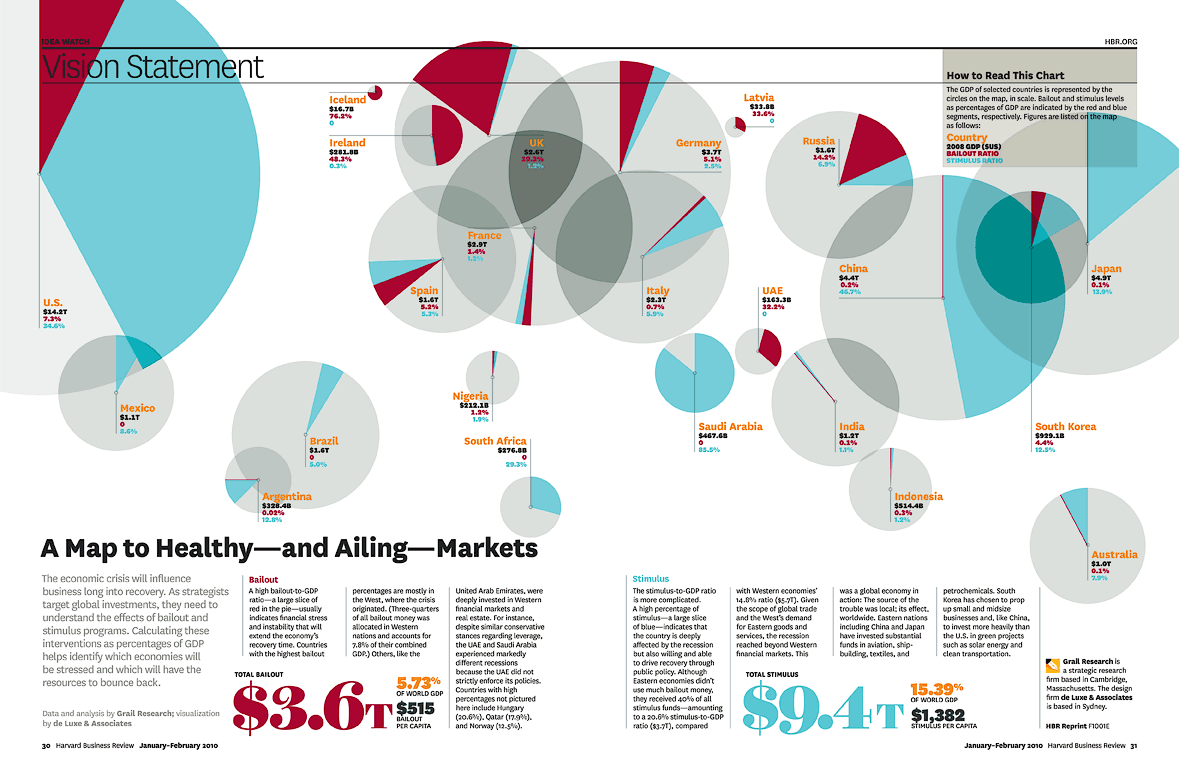 I had a knee jerk reaction when I saw this link on MR which was listed as Which country showed the most spending restraint during the financial meltdown?
It showed bailout money as a percent of GDP and that the U.S. was the largest while France was the smallest. The link to it was titled When Sh*t Hit The Fan, France Stuck To Its Ideals While The U.S. And U.K. Became Socialist Monsters.
My knee jerk reaction was duh! The graphic shows nothing. A country like France with larger government spending the either the U.S. or U.K. would be more constrained in being able to spend more. Duh!
On more careful reflection my reaction is the same. Only this time, a more careful examination resulted.
1. Bailout/stimulus spending really should be as a percent of GDP as already depicted but also government spending should be a percent of GDP and also be depicted and thus a more instructive graphic could be ratio of total government spending (including bailout/stimulus) to GDP.
2. Some googling brought me to the following link which tabulates government spending as a percentage of GDP. France is 7th at 61.1 while U.S. and U.K are 19.9 and 50.0 respectively(ranked at 50th and 37th). So the hypothesis that France is more constrained bears out.
3. More googling lead me to believe that perhaps the numbers above aren't correct. This link has U.S. government spending at 46 percent. Another MR link also has U.S. spending at roughly 40 percent. Calculations using FRED data series FGCEA and GDP is roughly 9 percent (1,200/14,000). The CBO numbers seem to be in accord with #2 however, while here NIPA numbers show it to be around 35%. So perhaps it's all a matter of definition.
4. Which leads back to the graphic which isn't clear at all as to what constitutes stimulus and bailout spending. Do I really believe that Nigeria tracks bailout and stimulus spending separately?
On the contradictions of banking
Their tension is built into their business: they are looking after other people's savings, yet they make their profits from lending them out, which must entail risks. "If we don't take risks, then we're not real bankers," says Tom Clausen, who ran Bank of America before he took over the World Bank. Bankers often stress that they are merely reacting to external events: like women in Victorian times, they are not required to take initiatives, only to say yes or no. "I'm just trying to deal with a succession of accidents," says Walter Wriston. "It's like surfing," says a partner of Barings, "just waiting for the next wave, and trying to keep upright." Yet the more they compete, the more aggressively the seek to lend. "This bank, " says Harold Cleveland, historian of Citibank, "has a tradition of being very conservative and very aggressive"; and other banks claim the same combination. It sounds contradictory, but it is the bankers' dilemma. A small customer who trusts a bank with his savings may be shocked to learn that his money has been lent aggressively across the world; or that what a bank calls its assets are in fact its loans. But bankers ever since Shylock have been accustomed to being reviled; their long suffering style assumes that their true value will never be appreciated. (pg. 21)
This is from The Money Lenders by Anthony Sampson, an interesting diversion through the history of banking until the late 1970s.
This is from The Money Lenders by Anthony Sampson, an interesting diversion through the history of banking until the late 1970s.
Quotes on bankers
Bankers are just like anyone else, except richer.
- Ogden Nash-
Banks have done more injury to religion, morality, tranquility, prosperity and even wealth of the nation than they can have done or ever will do good.
- John Adams, 1819 -
A "sound" banker, alas! is not one who foresees danger and avoids it, but one who, when he is ruined, is ruined in a conventional and orthodox way along with his fellows, so that no one can really blame him.
- J.M. Keynes -
Imprudent banks are supposed to be punished by the marketplace, by going out of business. But the banks were so interdependent that an imprudent bank could cause the collapse of the system.
- "Adam Smith" in Paper Money, 1981
Never before in the history of banking has so much been owed by so few to so few.
- The Economist, June 10, 1978 -
If you see a Swiss banker jump out of the window, jump after him, there's bound to be money in it.
- Voltaire -
If I owe a million dollars, then I am lost. But if I owe fifty billions, the bankers are lost.
- Celso Ming, Brazilian economist, 1980 -
Some unattributed ones I read somewhere and have forgotten, so they may not be correctly worded:
You don't have to make a lot of money to be rich. You just have to convince the banks to give you the money.
On the bailout:
Never has so much been owed by so few to so many.
- Ogden Nash-
Banks have done more injury to religion, morality, tranquility, prosperity and even wealth of the nation than they can have done or ever will do good.
- John Adams, 1819 -
A "sound" banker, alas! is not one who foresees danger and avoids it, but one who, when he is ruined, is ruined in a conventional and orthodox way along with his fellows, so that no one can really blame him.
- J.M. Keynes -
Imprudent banks are supposed to be punished by the marketplace, by going out of business. But the banks were so interdependent that an imprudent bank could cause the collapse of the system.
- "Adam Smith" in Paper Money, 1981
Never before in the history of banking has so much been owed by so few to so few.
- The Economist, June 10, 1978 -
If you see a Swiss banker jump out of the window, jump after him, there's bound to be money in it.
- Voltaire -
If I owe a million dollars, then I am lost. But if I owe fifty billions, the bankers are lost.
- Celso Ming, Brazilian economist, 1980 -
Some unattributed ones I read somewhere and have forgotten, so they may not be correctly worded:
You don't have to make a lot of money to be rich. You just have to convince the banks to give you the money.
On the bailout:
Never has so much been owed by so few to so many.
Securitization removes incentives to monitor
I never really bought this as a reason for the crisis.
In fact, for many Wall Street firms, it wasn't enough merely to be able to package mortgage backed securities. They wanted in on the whole process, from origination to packaging to selling and even to the exacting business of collecting people's mortgage payments and distributing them to MBS holders (known as servicing).
Lehman Brothers was the first Wall Street firm to really embrace all aspects of the mortgage business. Bill Dallas remembers:
(pg. 73)
This is from And Then the Roof Caved In by David Faber which was better than I had expected. One aspect that of the financial crisis that I did not realize was that the earnings smoothing scandal at Fannie Mae and Freddie Mac in 2003-2004 forced these GSEs to slow down their buying of MBS and created a vacuum for Wall Street firms to fill. Of course when the GSEs were let off the hook they stepped back in with a vengeance.
Also interesting was how seemingly easy it was to become a subprime lender. The book profiled Daniel Sadek who went from car salesman (Mercedes-Benz though) to subprime lender earning $5 million a month! And who was financing his operation? Wall Street.
In fact, for many Wall Street firms, it wasn't enough merely to be able to package mortgage backed securities. They wanted in on the whole process, from origination to packaging to selling and even to the exacting business of collecting people's mortgage payments and distributing them to MBS holders (known as servicing).
Lehman Brothers was the first Wall Street firm to really embrace all aspects of the mortgage business. Bill Dallas remembers:
What was Lehman's model? "We wanna originate it. So we're
gonna buy originators and we're gonna buy a servicer." And they were pretty
successful at it. They bought BNC Mortgage. They bought Finance America. They
bought their own service, called Aurora. Well, Wall Street firms are pretty much
lemmings. If Lehman's doing it and they're successful at it, then Bear Stearns
will go and Merrill will go and Goldman will go. They'll all go at it. And they
all did.
(pg. 73)
This is from And Then the Roof Caved In by David Faber which was better than I had expected. One aspect that of the financial crisis that I did not realize was that the earnings smoothing scandal at Fannie Mae and Freddie Mac in 2003-2004 forced these GSEs to slow down their buying of MBS and created a vacuum for Wall Street firms to fill. Of course when the GSEs were let off the hook they stepped back in with a vengeance.
Also interesting was how seemingly easy it was to become a subprime lender. The book profiled Daniel Sadek who went from car salesman (Mercedes-Benz though) to subprime lender earning $5 million a month! And who was financing his operation? Wall Street.
Subscribe to:
Posts (Atom)